

The healthcare reimbursement landscape continues to grow more complex, and insurance prior authorization remains one of the most resource-intensive administrative requirements providers face today. While the prior authorization process is designed to ensure medical necessity and cost control, it often creates operational bottlenecks, delays in treatment, and increased administrative burden. Healthcare organizations must navigate payer rules, documentation demands, and approval timelines while safeguarding revenue and patient satisfaction. As request volumes increase and staffing shortages persist, managing prior authorization challenges has become a top priority for revenue cycle leaders. Understanding the common prior authorization challenges in healthcare and how to overcome them is essential for improving operational efficiency, accelerating reimbursements, and ensuring timely patient care.
Streamline your prior authorization process today
Connect with our experts to reduce delays and denials
Impact of Prior Authorization on Patient Care Access
The impact of prior authorization on patient care access is one of the most persistent concerns in modern healthcare administration. Although prior authorization aims to control unnecessary spending and ensure appropriate care, delays in approvals frequently delay diagnostics, medications, and other related medical procedures. When approvals take days—or even weeks—patients may experience worsening symptoms, disease progression, or emotional stress. In urgent cases, treatment postponements can compromise outcomes entirely.
Key patient care impacts include:
- Delayed treatment initiation due to pending approvals
- Interrupted continuity of care when authorizations lapse
- Medication abandonment if approvals take too long
- Increased out-of-pocket costs when services proceed without authorization
- Reduced patient satisfaction and trust in providers
Balancing compliance with payer requirements while maintaining timely care delivery is a constant struggle for healthcare providers.
Top Prior Authorization Challenges in Healthcare
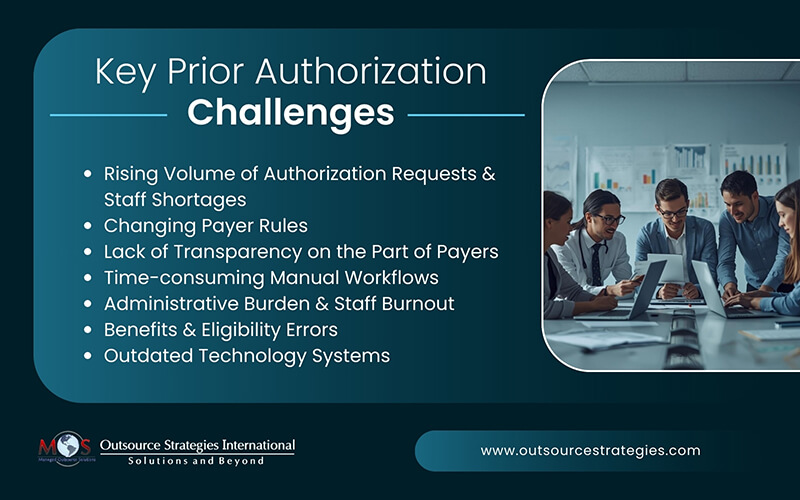
Healthcare providers face administrative and operational hurdles when managing prior approvals. Common prior authorization challenges in healthcare include evolving payer requirements, high volume requests, manual workflows, and frequent documentation errors. These obstacles often lead to delayed treatments, increased denials, and added strain on both staff and patients.
- Rising Volume of Authorization Requests & Staff Shortage: The growing volume of prior authorization requests has become a significant operational strain. As patient demand and payer requirements increase, providers must process a higher number of submissions within limited timeframes. At the same time, staff shortage may make it difficult to keep up with the workload, leading to processing delays, backlogs, and increased administrative pressure on existing teams. This imbalance slows down the authorization process and affects revenue cycle efficiency as well as timely patient care delivery.
- Changing Payer Rules: As insurers frequently update medical necessity criteria, documentation requirements, and approval guidelines, providers often struggle to keep submissions fully compliant. Even minor misunderstandings of these evolving policies can lead to delays or resubmissions, prolonging the authorization timeline. As a result, patients may face postponed treatments, interrupted care plans, and heightened anxiety while waiting for approvals, underscoring how payer complexity can hinder timely access to the necessary medical services.
- Lack of Transparency on the Part of Payers: Providers often struggle to determine whether specific services need approval, what documentation is required, or how long reviews will take due to lack of transparency. This uncertainty leads to repeated verification efforts, submission errors, and avoidable delays. Patients may experience postponed procedures or treatments while providers work to clarify payer expectations.
- Time-consuming Manual Workflows: Manual, paper-based, and phone-driven authorization processes significantly slow care delivery. When staff has to rely on faxes, call centers, and repetitive data entry, submission turnaround times increase. These inefficiencies delay approvals for medications, imaging, and procedures, directly affecting when patients can begin treatment. The longer the workflow, the greater the barrier to timely patient care access.
- Administrative Burden & Staff Burnout: Managing large-volume requests, tracking approvals, and handling follow-ups can lead to fatigue and burnout. As staff capacity declines, processing times lengthen and errors increase, further delaying patient services. This administrative strain ultimately translates into slower care coordination and reduced access for patients.
- Benefits & Eligibility Errors: Incorrect insurance details or incomplete eligibility verification can stall the authorization process at the outset. Even minor data inaccuracies may result in rejected or pended requests, requiring resubmission. These setbacks prolong approval timelines and can force patients to reschedule appointments or delay treatments, negatively affecting continuity of care.
- Outdated Technology Systems: Legacy systems and limited digital integration create major roadblocks in the authorization workflow. Without interoperable platforms, providers face data silos, manual tracking, and inefficient communication with payers. These technological gaps slow submission processing and status updates, delaying approvals and restricting patients’ ability to receive timely medical interventions.
The Role of Automation in Solving Prior Authorization Challenges
Digital transformation is rapidly reshaping authorization workflows.
- Automated Identification of Authorization Requirements: Automation tools can instantly determine whether a service requires prior authorization by analyzing payer rules and patient insurance data. This eliminates manual verification and reduces the risk of missed or unnecessary submissions.
- Clinical Documentation Extraction: Advanced systems use AI to extract relevant clinical data directly from EHRs. This ensures accurate, complete documentation is attached to requests, improving approval accuracy and reducing resubmissions.
- Denial Risk Prediction: Predictive analytics can flag authorization requests with a high likelihood of denial before submission. Staff can then correct errors or add documentation proactively, improving first-pass approval rates.
- Auto-Population of Submission Forms: Automation platforms pull patient demographics, insurance details, and clinical information into authorization forms automatically. This minimizes manual data entry, reduces errors, and accelerates submission timelines.
- Real-time Status Tracking: Automated dashboards provide live updates on authorization status. Staff can monitor approvals, follow up on pending cases quickly, and prevent treatment delays caused by lack of visibility.
Automation not only reduces prior authorization denials but also enhances compliance and operational efficiency.
Best Practices to Optimize the Prior Authorization Process
- Standardize Authorization Workflows: Creating uniform procedures for submissions ensures consistency, reduces errors, and improves processing efficiency across teams.
- Develop Payer-specific Submission Checklists: Maintaining checklists tailored to each payer’s requirements helps ensure complete documentation and minimizes avoidable denials.
- Track Key Performance Indicators (KPIs): Monitoring metrics like approval turnaround time and denial rates helps identify bottlenecks and opportunities for improvement.
- Implement Electronic Prior Authorization (ePA) Tools: Digital submission platforms accelerate request processing, reduce manual work, and improve communication with payers.
- Integrate EHR and RCM Platforms: System integration enables seamless data sharing, reducing duplicate entry and speeding up authorization workflows.
- Use Analytics to Identify Denial Trends: Data insights help organizations pinpoint recurring denial causes and implement corrective strategies proactively.
- Create Dedicated Authorization Teams: Specialized teams improve focus, expertise, and turnaround time for managing high authorization volumes.
- Provide Ongoing Payer Policy Training: Regular staff training ensures teams stay updated on evolving payer rules and submission requirements.
Navigating common prior authorization challenges in healthcare requires a strategic blend of people, processes, and technology. From rising request volumes and payer complexity to manual workflows and outdated systems, each barrier can disrupt both revenue cycles and care delivery. Most importantly, the impact of prior authorization on patient care access cannot be overlooked. Delays in approvals directly affect treatment timelines, patient outcomes, and provider trust. By modernizing the prior authorization process, leveraging automation, improving payer collaboration, and strengthening front-end accuracy, healthcare organizations can reduce prior authorization denials, ease administrative burden, and ensure patients receive timely, necessary care.
Optimize approvals and accelerate patient care.
Partner with us for smarter prior authorization solutions.

More from This Author