
Denial management has grown from a back-office necessity into a strategic priority for organizations focused on financial health and patient satisfaction. Medical claim denial management—the systematic process of identifying, addressing, and preventing denied insurance claims—is crucial for minimizing revenue leakage. Traditionally, this process relied heavily on manual work and involved significant administrative costs. However, the use of AI in healthcare denial management is now reshaping how providers handle denials by transforming reactive workflows into proactive, intelligent systems. This shift is not just a boost to operational performance—it is redefining denial management strategies across the healthcare industry.
Why Denial Management Matters
Denied claims are more than paperwork setbacks; they directly affect a provider’s revenue cycle. Every denied claim represents delayed payment or lost revenue, disrupting cash flow and increasing operational costs. According to industry data, a significant percentage of denied claims never get reworked and re-submitted, resulting in permanent revenue loss. Efficient denial management is essential not just for financial stability, but for overall organizational flexibility and patient experience.
Reduce claim denials and boost revenue cycle efficiency with AI
The Role of AI in Healthcare Denial Management
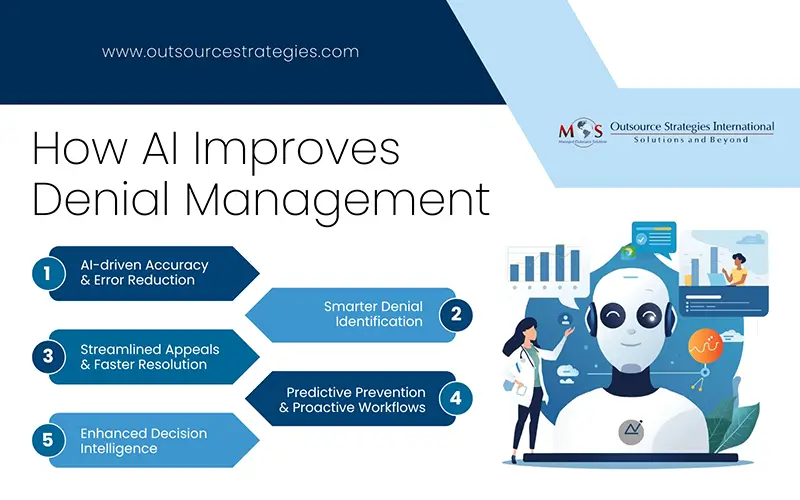
AI technologies are fundamentally changing the landscape of denial management through automation, predictive analytics, and continuous learning. The integration of AI into denial workflows improves accuracy. Let us see how AI improves denial management in healthcare:
- AI-driven Accuracy and Error Reduction: One of the biggest challenges in denial management is human error — whether it’s incorrect patient data, inaccurate billing codes, or missing documentation. These errors may lead to claim denials and costly rework. Here is where AI in healthcare denial management brings real value:
- Automated data entry and validation: AI systems extract and validate claim data, reducing reliance on manual processes and lowering the risk of human error.
- Real-time error detection: Before claims are submitted to payers, AI analyzes them for discrepancies such as mismatched patient information or incorrect procedural codes.
- Proactive risk reduction: By learning from historical denials, AI flags at-risk claims, enabling teams to correct problems before submission.
These capabilities not only reduce denial rates but also improve first-pass claim acceptance, meaning healthcare providers receive accurate reimbursements faster.
- Smarter Denial Identification and Categorization: Traditionally, denial categorization involves manually reviewing large volumes of claims — a time-intensive task prone to oversight. With healthcare denial management automation, AI systems automatically detect denial reasons, categorize denials, and prioritize them based on severity. With advanced pattern recognition and historical analysis, AI can:
- Automatically classify denial reasons such as coding errors or missing authorizations.
- Identify recurring denial patterns across claim portfolios.
- Prioritize workflow responses so teams focus on high-impact cases first.
This level of automation frees staff from repetitive business processes and enhances overall denial processing efficiency.
- Streamlined Appeals and Faster Resolution: Appealing denied claims is a frustrating and labor-intensive part of the revenue cycle. AI transforms this aspect of denial management by:
- Generating customized appeal letters tailored to the specific denial reason.
- Analyzing past successful appeals to recommend the most effective appeal strategies.
- Tracking appeal status in real time to ensure timely follow-up and improve success rates.
By automating appeal preparation and tracking, providers can reduce turnaround time and improve overturn rates — a key metric in effective denial management strategies.
- Predictive Prevention and Proactive Workflows: Another most compelling benefit of AI is its predictive capabilities. Instead of simply reacting to denials, providers can now anticipate them before they occur. AI systems analyze historical claims data and trends to:
- Predict which claims are likely to be denied and why.
- Suggest corrective actions before submission.
- Monitor payer-specific patterns and adjust processes accordingly.
This proactive stance significantly reduces overall denial rates, improves workflow planning, and enhances denial management as a strategic business function.
- Enhanced Decision Intelligence and Insights: Beyond automating tasks, AI provides valuable insights that support better decision-making. Rather than merely flagging errors, advanced systems help providers understand the root causes of denials, identify systemic issues, and refine denial-prevention protocols. With real-time reporting, healthcare organizations get:
- Detailed analytics on denial trends
- Recommendations for workflow adjustments
- Alerts for recurring issues.
This analytical power enables data-backed denial management strategies that continually improve and adapt.
The Future of AI in Healthcare Denial Management
Experts predict several major trends:
- Advanced Predictive Analytics: AI will refine risk-scoring models that predict denial outcomes with greater precision.
- Full Automation from Submission to Resolution: The denial lifecycle will be covered end-to-end by intelligent systems, reducing manual points of failure.
- Natural Language Processing (NLP) Integration: NLP will extract meaning from unstructured clinical notes, further reducing documentation-related denials.
- Integration with EHR and RCM Platforms: AI will become a seamless part of the revenue cycle stack, improving interoperability and boosting efficiency.
These advancements promise not only faster denial resolution but deeper strategic value, turning denial management into a competitive advantage for healthcare organizations.
Streamline claims, cut costs, and improve reimbursements with AI.
AI is not just enhancing denial management — it is redefining it. With AI in healthcare denial management, healthcare providers can replace slow, reactive workflows with proactive, data-driven systems. From enhanced accuracy and automated workflows to predictive prevention and deep analytical insights, AI is transforming every aspect of the denial management lifecycle. As technologies evolve, AI will continue to expand its role, making denial management faster, smarter, and more strategic than ever before.

More from This Author