- Why Eligibility Verification Mistakes Create Revenue Risks
- How Automated Eligibility Checks Strengthen Front-end Accuracy
- Key Benefits of Implementing Automated Eligibility Verification Systems
- Best Practices for Automating Eligibility Checks
- Why AI and Human Oversight Are Essential for Achieving RCM Stability
Patient eligibility tasks remain one of the most persistent challenges in healthcare revenue cycle management. Traditional methods for insurance verification are fraught with time-consuming, error-prone manual workflows. These inefficiencies cause higher administrative rework and frequent billing errors, resulting in increased denials, payment delays, and reduced cash flow.
Healthcare providers can now automate eligibility checks to reduce manual verification efforts, supporting faster and more accurate claim submissions. By leveraging AI-driven insurance verification, practices can verify coverage in real-time, supporting a higher first-pass clean claim rate and streamlining overall revenue cycle operations.
Why Eligibility Verification Mistakes Create Revenue Risks
Eligibility errors affect multiple billing stages and create avoidable financial exposure for practices.
- Slower Intake and Claim Creation: Manual verification through payer portals and phone calls delays patient intake. This administrative lag slows down the entire claim lifecycle before the clinical encounter even begins.
- Incomplete Coverage Validation: Without real-time automation, it is easy to miss inactive policies, plan exclusions, and specific prior authorization requirements. These gaps may surface only after claims are submitted.
- Administrative Rework and Resource Strain: Claims with incorrect eligibility details are frequently pended or rejected. This necessitates extensive staff time for correction and resubmission, diverting focus from high-value tasks such as denial management and patient collections.
- Longer Payment Timelines: Eligibility errors delay claim resolution and push outstanding balances further into accounts receivable. Extended payment cycles make cash flow unpredictable.
- Ongoing Revenue Exposure: As coverage rules change more frequently, manual verification becomes harder to manage. Without automation, practices remain vulnerable to recurring errors.
How Automated Eligibility Checks Strengthen Front-end Accuracy
Automating eligibility checks streamlines daily billing operations by creating faster, more consistent front-end workflows. This helps RCM teams to proactively identify and eliminate errors long before claims reach payer systems.
- Real-time Coverage Verification: Automated tools confirm active insurance status, plan type, and payer details instantly. This ensures only valid coverage information enters the billing workflow, reducing avoidable claim rejections.
- Precise Patient Financial Responsibility Checks: Advanced verification systems confirm co-pays, deductibles, and coverage limits upfront. This prevents underpayments and patient disputes later.
- Reduced Claim Errors at Submission: By validating eligibility before claims are created, AI-enabled systems prevent incorrect payer selection and inactive policy submissions. This improves first-pass acceptance rates.
- Faster Billing Turnaround: With insurance details verified in real time, claims can be processed immediately. Practices maintain steady submission schedules, even in high-volume periods.
- Lower Administrative Burden: Staff no longer needs to log into multiple payer portals or document verification manually. This frees administrative teams to focus on follow-ups and resolution.
AI-driven eligibility checks strengthen coverage accuracy at the earliest stage, helping practices reduce rework, minimize delays, and improve reimbursement consistency.
Key Benefits of Implementing Automated Eligibility Verification Systems
Automated insurance verification replaces manual, inconsistent checks with structured, real-time validation. By verifying coverage accurately at the front end, organizations move claims through the billing cycle with fewer interruptions.
Here’s how automation delivers measurable impact:
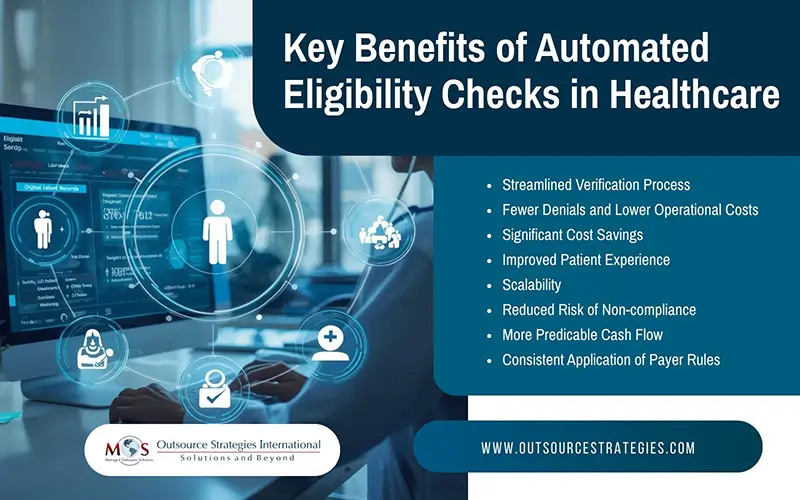
- Streamlined Verification Process: Automated systems verify coverage and policy status instantly during registration, reducing wait times and eliminating follow-up calls. This ensures a seamless process across staff and departments.
- Fewer Denials and Lower Operational Costs: Automation reduces errors related to inactive coverage, incorrect plan types, and missing payer details—common causes of preventable denials. Clean data ensures claims are submitted correctly the first time.
- Significant Cost Savings: Automation decreases manual labor for verification, claim corrections, and payer follow-ups. Fewer errors lower administration costs and free up resources for high-priority tasks.
- Improved Patient Experience: Instant coverage verification at the front end speeds up registration and reduces delays. This minimizes confusion and fosters a smoother, more transparent patient-provider relationship.
- Scalability: Automated systems handle large volumes of verifications without slowing workflows. Practices can manage seasonal spikes effectively while maintaining operational efficiency.
- Reduced Risk of Non-compliance: Automation confirms coverage details and patient responsibility before billing, preventing claims that violate HIPAA or payer policies. This ensures compliance and reduces the risk of costly penalties.
- More Predicable Cash Flow: By minimizing insurance-related errors, practices increase the percentage of claims paid in full and on time. This reduces fewer payment delays and stalled claims, allowing for steadier collections and stronger financial stability.
- Consistent Application of Payer Rules: Automated systems verify coverage requirements, authorization needs, and plan limitations according to payer-specific guidelines, reducing errors from manual interpretation. Regular updates ensure verification processes stay current with the latest payer rules.
Best Practices for Automating Eligibility Checks
Implementing automated eligibility checks can significantly improve your practice’s billing process, but it requires a strategic approach to integration. Implementing the following best practices ensures that the automated system functions as an effective component of your revenue cycle management strategy:
- Assess Workflows: Before implementing automation, practices must map out existing verification processes to identify specific bottlenecks, common errors, and manual touchpoints. Understanding where these delays occur allows for targeted automation that addresses the root causes of claim denials. It is equally important to select AI-driven verification tools that integrate seamlessly with your existing EHR system.
- Standardized Data Entry: Verification should begin at the point of initial registration or scheduling. Ensure patient demographics, insurance IDs, and policy information are accurately captured at intake. Validating coverage details before services are rendered allows for proactive patient communication regarding their financial responsibility.
- Automated Alerts: Automated systems are only effective if payer rules are current. Ensure your platform receives timely updates and review rules periodically to avoid compliance gaps. Configure automated alerts to flag any discrepancies in a patient’s coverage, such as plan transitions or updated deductibles.
- Monitor and Audit Claims: While automation reduces manual error, periodic audits are essential. Continuously track verification accuracy, claim rejection rates, and first-pass acceptance rates. Regular audits help identify system gaps and ensure the claim data aligns with payer expectations and clinical records.
- Train Staff Regularly: Automation serves as an extension of the administrative team, not a total replacement. Staff must be trained regularly to navigate the system efficiently and handle exceptions—complex cases where manual intervention is required to resolve specific coverage nuances.
- Establish Clear Patient Communication: Clear communication regarding out-of-pocket costs is essential for a positive patient experience. When automated checks identify coverage limitations, the staff should be equipped to discuss any queries with the patient upfront. This transparency fosters a stronger provider-patient relationship and better patient collections.
- Regular System Update: The healthcare insurance landscape is subject to constant regulatory shifts. It is essential to ensure that your automated verification system is updated with the latest payer rules and plan changes. Regular updates minimize errors caused by outdated information and maintain compliance with HIPAA and payer-specific guidelines.
By following these best practices, practices can ensure smooth eligibility verification processes, reduce administrative burdens, and improve overall financial outcomes.
Why AI and Human Oversight Are Essential for Achieving RCM Stability
The increasing complexity of healthcare billing, coupled with rising administrative costs, has made automating eligibility verification a critical component of efficient revenue cycle management. By replacing manual verification processes with AI-driven systems, practices can improve accuracy, reduce errors, and strengthen cash flow stability.
However, technology alone is often not enough to navigate the nuances of complex payer requirements and frequent policy updates. Insurance verification services combine advanced automation with expert human oversight, allowing healthcare providers to minimize time spent on administrative tasks and focus more on patient care. For modern practices, outsourcing can be a strategic choice, helping to create a more resilient revenue cycle, ensure consistent reimbursement, and support long-term financial health in an increasingly demanding regulatory environment.
Ensure faster, error-free billing with our expert insurance verification services.

More from This Author