

Gastroenterology billing is challenging due to complex coding requirements, billing multiple payers, limited insurance coverage, and other challenges like documentation requirements, changing regulations, and prior-authorization requirements. It is important for healthcare providers to have a thorough understanding of these factors to ensure proper billing and avoid denials and appeals. This article explores gastroenterology medical billing errors, outlines the key pitfalls in gastroenterology medical billing and coding services and offers tips for accurate gastroenterology billing and coding.
The Landscape – Why Gastroenterology Billing Is High-risk
Gastroenterology practices perform a wide variety of procedures (endoscopies, colonoscopies, therapeutic interventions, biopsies, etc.). These practices need to frequently coordinate with other providers (anesthesia, pathology, imaging), and often deal with multiple payers with varying requirements. Due to its complexity, it is not surprising that gastroenterology medical billing errors remain among the most common causes of claim denials, audits, and compliance risks. Therefore, identifying and avoiding these common errors is crucial.
Common Challenges in Billing Gastroenterology Procedures
Here discussed are some of the top challenges of billing gastroenterology procedures –
- Inaccurate Coding – Accurate coding is essential to ensure proper reimbursement and avoid costly audits. Mistakes in medical code selection can lead to under-billing or overbilling, which can result in financial losses or legal complications. To avoid these billing pitfalls, regularly educate your billing staff on updated codes and guidelines. Encourage them to double-check codes and review documentation to ensure accurate coding. In order to avoid gastroenterology billing and coding errors-
- Make sure your billing staff is properly trained on the latest CPT and ICD codes.
- Use a coding and billing software system to help ensure accuracy.
- Double-check all codes before submitting claims.
- Review documentation regularly to make sure it supports the codes used.
- Incomplete Documentation – Proper documentation is essential not only for coding accuracy but also for supporting medical necessity and justifying the services provided. Incomplete records can result in claim denials, delayed payments, or even legal disputes. To avoid this pitfall, it is important to ensure that healthcare providers document all necessary information, including symptoms, procedures, and patient history.
- Failure to Verify Insurance Coverage – Establish a reliable system for insurance verification that ensures all patient details are confirmed prior to service. Conduct coverage verification at the time of scheduling to avoid unexpected denials or coverage gaps later on. Additionally, confirm the patient’s specific benefits and any prior authorization requirements in advance to ensure that all services are covered and compliant with the insurer’s policies. Taking these proactive steps streamlines billing and safeguards your practice’s financial health.
- Ignoring Billing Compliance Regulations – Healthcare billing must adhere to strict standards set by the Health Insurance Portability and Accountability Act (HIPAA) and the False Claims Act. Failure to comply can result in huge financial penalties and harm to the practice’s reputation. To prevent such risks, regularly review updates from the CMS and your state’s Medicaid agency. Additionally, ensure that all billing staff receive ongoing training on compliance topics, including coding accuracy, medical necessity, and documentation standards. Establishing a comprehensive compliance program is equally important – it should outline clear policies and procedures, conduct regular audits, and include periodic reviews to ensure every aspect of your billing process aligns with current regulations.
- Billing Multiple Payers – Gastroenterology procedures are often billed to multiple payers, including Medicare, Medicaid, and private insurance providers, each with its own distinct set of rules and regulations. To manage multi-payer billing effectively, start by verifying the patient’s insurance coverage and identifying the primary payer. Since each payer may have different documentation and coding requirements, it is essential to understand and adhere to their specific policies and procedures.
- Neglecting Prior Authorization – Many procedures require advance approval from insurance providers and failing to obtain it can lead to claim denials and treatment delays. To prevent this, establish a clear and proactive process for managing prior authorizations and ensure all staff are trained to follow it consistently. Identify which procedures require authorization for each insurer. Submit authorization requests as early as possible to allow sufficient time for review and approval before the scheduled procedure.
- Inefficient Claims Management – Delays in claim submission, resubmission, or follow-up often lead to unnecessary administrative pressure and increased instances of gastroenterology claim denials. To prevent this, implement a robust claims management system that automates routine tasks and streamlines the entire process. Establish clear and well-documented claims procedures so that staff can submit claims accurately and on time. Regularly track and monitor all submitted claims to identify delays or denials early and ensure prompt follow-up with insurance companies to resolve issues efficiently.
Enhance accuracy and reduce claim denials with our professional billing and coding support.
Tips for Accurate Gastroenterology Billing and Coding
Below are key strategies and best practices to help gastroenterology practices strengthen billing accuracy and reduce costly claim denials.
- Ensure Complete and Clear Documentation -. Every gastroenterology procedure should have complete, legible notes that reflect what was performed, why it was medically necessary, and the outcome. Key documentation elements include – pre-procedure indications or patient symptoms, details of the procedure (e.g. colonoscopy with biopsy or polyp removal), findings, complications, and specimen collection and post-procedure care notes. Incomplete documentation is a primary source of gastroenterology medical billing errors, because coders cannot assign the correct CPT and ICD-10 codes.
- Stay Updated on Coding Guidelines – Gastroenterology practices must keep pace with updates to CPT, HCPCS, and ICD-10 codes, as well as payer-specific billing policies. Annual updates often change how certain procedures are coded, bundled, or reimbursed. Professional gastroenterology medical billing and coding services can help practices remain compliant and avoid outdated practices that lead to denials.
- Use the Correct Modifiers – Modifiers play a critical role in gastroenterology coding, particularly for procedures involving multiple interventions during a single session. Incorrect or missing modifiers can result in gastroenterology claim denials or underpayment.
- Implement a Strong Claims Management Process – Practices should establish workflows that ensure every claim is submitted, tracked, and resolved promptly.
- Verify Insurance Eligibility and Obtain Prior Authorizations – Failing to verify coverage or obtain approval often leads to immediate gastroenterology claim denials.
- Conduct Regular Internal Audits – Periodic internal audits are one of the most effective ways to detect and prevent billing errors. Reviewing a random selection of claims each month can uncover trends, documentation gaps, or coding inconsistencies. Audits also ensure compliance with payer rules and help identify areas for staff retraining.
- Partner with a Specialized Billing Provider – Partnering with professional gastroenterology medical billing and coding services can significantly improve accuracy and efficiency. A reliable billing partner has expertise in gastroenterology-specific CPT and ICD-10 codes, provides dedicated denial management and appeals support, and ensures detailed revenue cycle reporting and compliance with HIPAA and payer requirements.
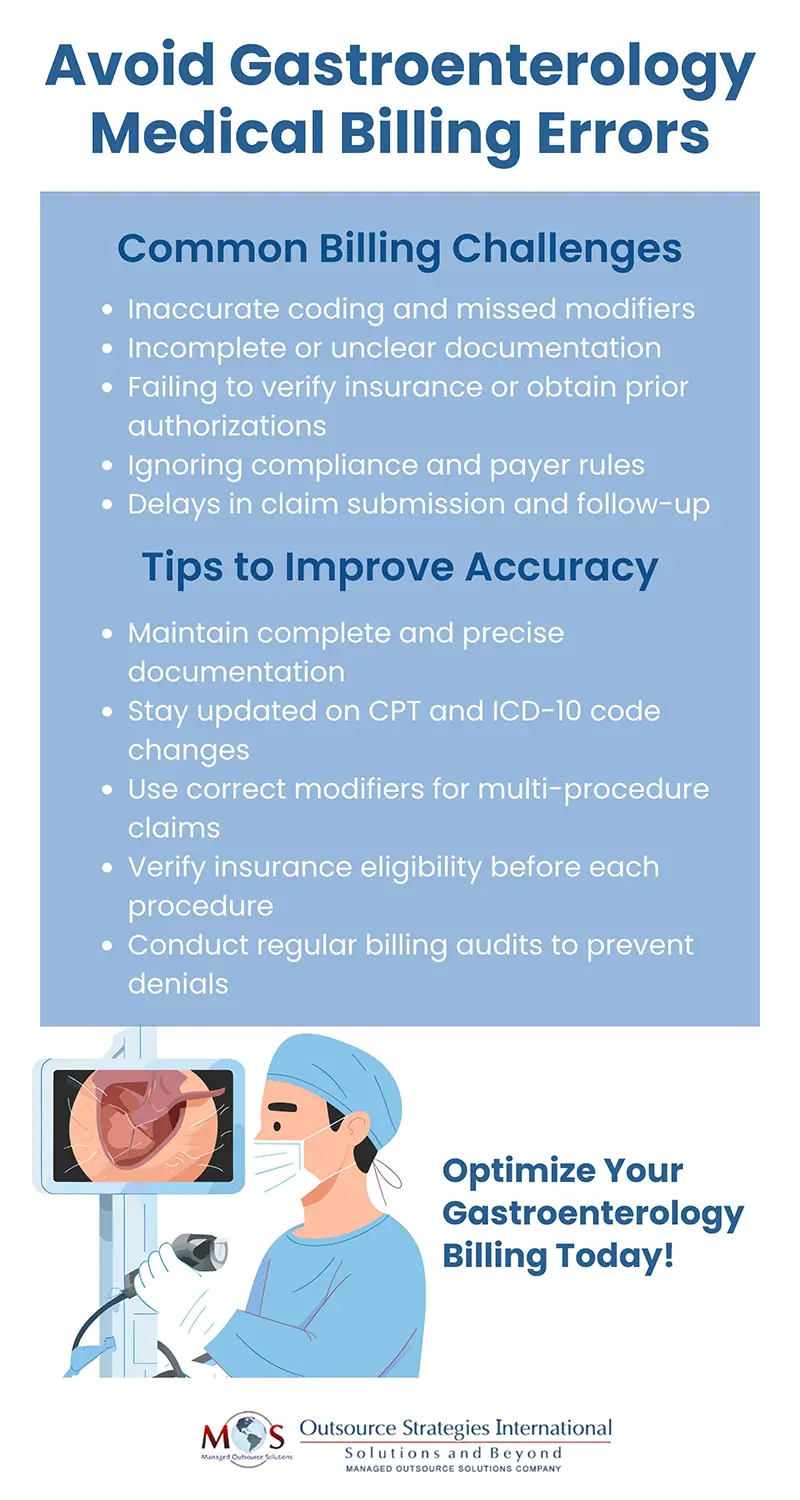
Gastroenterology practices face significant administrative, financial, and regulatory challenges. Common gastroenterology medical billing errors such as incorrect coding, insufficient documentation, claim-submission delays, and missed authorizations – can jeopardize cash flow and compliance. By recognizing the top challenges of billing gastroenterology procedures and applying the tips for accurate billing and coding outlined in this post, medical providers can reduce claim denials, ensure faster reimbursements and minimize legal and compliance risk.
Enhance accuracy, reduce claim denials, and ensure faster reimbursements with professional billing and coding support.

More from This Author