

Every year, healthcare providers face new challenges created by complex regulatory changes, strict insurer policies, and rising operational costs. Among these, denial management remains one of the most time-consuming and persistent concerns impacting the financial stability of a practice. According to recent data on ACA marketplace claim denials reported by KFF,
- 19% of in-network claims and 37% of out-of-network claims were denied
- Common reasons for denials included “other” at 34%, administrative reasons at 18%, excluded service at 18%, lack of prior authorization at 9%, and lack of medical necessity at 6%
These emerging denial trends have pushed many healthcare practitioners to rethink their revenue cycle strategies and invest in more proactive denial management strategies. Practices are increasingly recognizing the need for smarter, data-driven workflows that streamline administrative tasks, reduce manual errors, and help billing teams stay ahead of payer requirements.
Key Emerging Healthcare Denial Trends in Revenue Cycle Management
With payers adopting new technology, updating coverage rules, and tightening documentation criteria, providers are rethinking how they manage claims. Insurers now review documentation, eligibility, and coding accuracy with far more precision. As a result, practices are seeing denial patterns that look very different from previous years.
Below are the key trends creating the biggest impact on the revenue cycle:
- Higher First-Pass Denials on High-Cost Services
Payers are using advanced analytics to review expensive claims such as imaging, specialty drugs, and surgical procedures. What this means for providers:
- Even clean claims in these categories face higher rejection rates
- Billing teams must prepare for increased payer scrutiny on high-value encounters
- Increased Focus on Documentation Precision
Insurers are comparing clinical notes with submitted codes using natural language processing tools:
- Missing details such as co-morbidities or vague medical necessity statements can trigger an insurance claim rejection
- Practices need stronger documentation habits and clearer clinical narratives
- Shift towards Predictive Denial Prevention
Payers are prioritizing predictive analytics in healthcare billing to prevent denials rather than relying on post denial appeals.
- Claims that are considered high risk are flagged before submission
- Teams must focus more on front-end accuracy rather than relying on appeals to correct issues later
- Rising Eligibility Related Denials
Coverage instability driven by Medicaid redeterminations and ACA subsidy shifts is causing more midyear insurance losses.
- More patients are showing up without active coverage
- Real-time eligibility checks at every visit are becoming essential
- Stricter Prior Authorization Requirements
New federal rules will push payers to standardize electronic prior authorization processes.
- Incorrect or incomplete PA submissions are more likely to be denied
- Automated and well-organized PA workflows will be critical
- Growing Denials Tied to Payer Specific Coding Rules
Payers are enforcing stricter criteria for certain CPT and HCPCS codes based on policy updates.
- Claims are denied when coding does not match the latest payer policies
- Teams need more frequent reviews of code level changes and updated payer guidelines
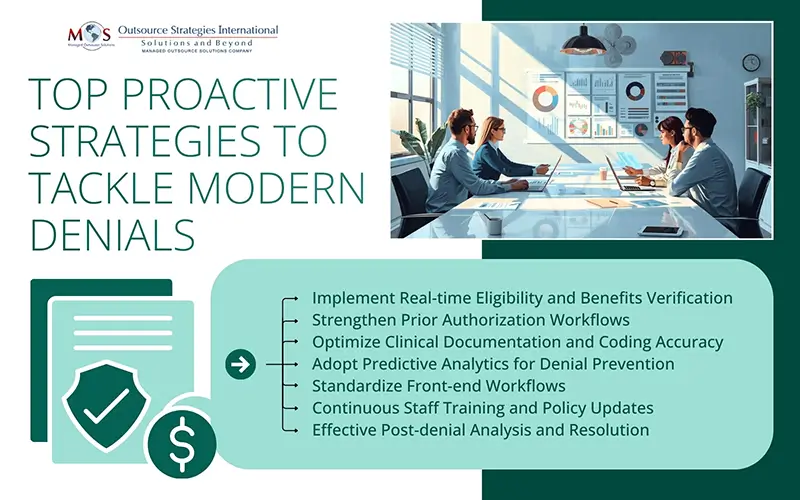
Best Denial Management Strategies For Healthcare Providers
Healthcare providers can reduce claim rejections and improve revenue by adopting proactive strategies that focus on accuracy, automation, and predictive insights. The following approaches have proven effective in tackling denials:
- Implement Real-time Eligibility and Benefits Verification
Verifying patient eligibility at the point of care is essential to prevent coverage-related claim rejections. Automated systems can instantly check insurance status, benefit limits, and plan-specific rules for each patient. This reduces the risk of submitting claims for inactive coverage or services outside the plan’s scope. By identifying eligibility issues before claim submission, practices can minimize costly corrections and delays, ensuring smoother claim processing and fewer rejections.
- Strengthen Prior Authorization Workflows
Prior authorizations are a common cause of administrative claim rejections. Digitized PA workflows help ensure requests are complete, compliant, and submitted on time. Tools that track approvals, send alerts for missing information, and integrate directly with payer portals reduce the risk of errors and delays. By streamlining PA processes, staff spend less time managing approvals manually and more time on patient care, while the likelihood of authorization-related denials drops significantly.
- Optimize Clinical Documentation and Coding Accuracy
Accurate coding and documentation are critical in reducing denials tied to medical necessity, payer-specific rules, and procedural errors. AI-driven medical coding tools can assist coders by suggesting the most appropriate codes based on patient records, flagging inconsistencies, and identifying missing information before claims are submitted. Natural Language Processing helps extract relevant clinical details from physician notes, ensuring that the documentation supports the services billed. Standardized coding practices across teams also reduce discrepancies, making claim submissions more consistent and compliant.
- Adopt Predictive Analytics for Denial Prevention
Predictive analytics helps identify claims that carry a higher risk of denial before they are submitted. By analyzing historical denial data, payer behavior, and claim attributes, these tools flag potential problem areas in real time. This allows teams to correct issues such as incomplete documentation, coding mismatches, or policy noncompliance before the claim reaches the payer. The result is a shift from reactive denial management to proactive prevention, saving administrative time and protecting revenue.
- Standardize Front-end Workflows
Ensuring accurate and complete data collection at intake is a foundational step in denial prevention. Standardizing workflows for patient registration, insurance verification, and data entry reduces errors that often cascade into claim rejections. Front-end consistency also improves overall operational efficiency, as staff can rely on clear processes for handling patient information and submitting claims. A streamlined front-end workflow supports all downstream processes, from coding to billing to reimbursement.
- Continuous Staff Training and Policy Updates
Ongoing education is important to keep teams aligned with payer rules, regulatory requirements, and internal workflow changes. Regular training sessions on documentation standards, coding updates, and denial prevention strategies will help clinical workers to recognize potential errors before claims are submitted. Staying current with policy changes also ensure compliance with evolving payer expectations, which reduces rejections and improves reimbursement rates. An informed and trained RCM team can handle complex scenarios more effectively, supporting a stronger and more predictable revenue cycle.
- Effective Post-denial Analysis and Resolution
Even with proactive measures, some denials are inevitable. Having a structured process to review and address them quickly can prevent revenue loss. Practices can categorize denials by type, payer, and cause to identify recurring issues. Automated tools can flag patterns, suggest corrective actions, and track appeal progress. By resolving denials promptly and learning from them, teams can refine workflows, prevent similar issues in the future, and maintain a healthier revenue cycle.
Key Performance Indicators of Denial Management
Tracking the right performance metrics helps providers understand whether their denial prevention strategies are working. The following KPIs offer clear visibility into financial and operational performance:
- First Pass Claim Rate: This metric shows the percentage of claims that are paid on the first submission, which reflects the accuracy of coding, completeness of documentation, and effectiveness of front-end workflows.
- Denial Rate by Category: Breaks down rejections based on specific reasons such as eligibility issues, authorization failures, medical necessity concerns, or coding errors, allowing teams to pinpoint the exact areas that require improvement.
- Days in Accounts Receivable: Measures the average number of days it takes for claims to be reimbursed and provides a clear picture of how efficiently the billing and denial resolution processes are functioning.
- Reduction in Write Offs: Tracks the percentage of rejected claims that ultimately become uncollectible, and a lower write off rate shows that appeals are being handled effectively and denial prevention strategies are working.
- Prior Authorization Turnaround Time: Measures how long it takes to obtain approval for services that require prior authorization. Shorter turnaround times reflect strong workflow management and reduced risk of PA related denials.
Together, these KPIs give providers a clear way to measure progress, identify gaps, and ensure that their denial management efforts are moving the revenue cycle in the right direction.
Partner with a Proven Denial Management Service Provider
As payer expectations become more complex, denial management can no longer be treated as a back-end correction process. To streamline operations, many practices are turning to professional denial management services that combine proactive prevention, timely follow-up and data-driven insights. These external specialists stay aligned with evolving payer behavior, identify recurring denial patterns, monitor performance closely, and help reduce overall denial rates. This allows providers to deliver quality care and maintain stronger control over their revenue cycle without increasing internal administrative burden.
Say goodbye to billing headaches and hello to faster reimbursements with our expert billing team!

More from This Author