
Every year, medical practices lose significant revenue not only to patient no-shows or reimbursement cuts, but also to a decision they assume is saving them money: in-house billing. What appears to be a smart financial move on the surface can quietly introduce hidden expenses, processing delays, and slower cash flow. Even well-trained staff may struggle with operational inefficiencies, administrative overhead, and billing mistakes, all of which affects a practice’s maximum revenue potential.
As healthcare regulations grow more complex along with escalating costs, many practices are re-evaluating whether running an internal billing department remains financially practical. For healthcare providers, outsourcing medical billing has become a strategic alternative to improve collections, reduce denials, and stabilize revenue flow. The choice between outsourced and in-house billing is no longer about preference — but about which approach best supports long-term financial sustainability.
Hidden Revenue Loss from In-house Billing for Practices
In-house billing may seem cost-effective at first, but it introduces several hidden risks that quietly affect revenue. Administrative staff at many practices may have to operate with various limited capacities and rely heavily on manual workflows. When operational issues such as an increase in patient volume or staff availability cause delays, it can result in mistakes that affect billing performance and reimbursement timelines. Below are some of the overlooked factors:
- Staffing Expenses and Training Gaps: Practices must cover full-time salaries, benefits, and overtime during high-volume periods. When billing staff leave or take extended time off, claim processing slows, and accuracy can drop. New hires require training and supervision, which can delay billing workflows and increase claim error risks.
- Technical Upgrades: Internal teams rely on billing software for eligibility checks, claim submissions, and invoice processing, all of which require ongoing expenses such as licensing, maintenance, and system upgrades. Technical issues also require IT support, which increases administrative overhead.
- Inconsistent Follow-ups: Follow-up on unpaid or partially paid claims may be delayed when staff handles multiple administrative duties. This reduces recovery rates and increases the number of aging accounts. The longer accounts remain unpaid, the harder they become to collect. This increases the likelihood of partial payments or write-offs.
- Manual Workflows and Reworks: Manual data entry, verification, and claim tracking slow daily operations and increase the chance of missed or incorrect information. Billing errors and missing information require additional staff time to correct, resubmit, and follow up on claims. This hidden rework effort reduces productivity and delays revenue recovery.
- Certification Costs: Internal teams may struggle to stay current with frequent coding and payer policy changes. This can lead to rejected claims, additional rework, and avoidable payment delays. Practices need to invest in regular certification programs, workshops, and training to stay current with coding changes, payer rules, and compliance updates. These programs take time and add recurring expenses.
- Claim Backlogs: Daily claim volumes can accumulate when staff gets overwhelmed with administrative tasks or when patient volume increases. Over time, these backlogs delay when claims reach payers and push reimbursement timelines further out. Claims that sit for too long may also become harder to collect, leading to increased write-offs or partial payments.
- Compliance Risks: In-house teams may have difficulty staying on top of changing regulations, payer rules, and insurance requirements. Failure to comply with these regulations can result in fines, audits, or loss of payer contracts, putting both revenue and reputation at risk.
- Limited Scalability: As practices grow or experience seasonal fluctuations in patient volume, it can be difficult to scale billing operations effectively. Without additional resources or streamlined processes, the quality of the workflow may decline, resulting in lost revenue opportunities.
- Ineffective Reporting and Analytics: Teams may lack the tools or expertise to generate meaningful reports on billing performance, aging accounts, or denial trends. Without this data, practices miss opportunities for optimization, leaving revenue recovery potential untapped.
- Cash Flow Disruptions: Errors or delays in the billing process can create unpredictable cash flow, especially when reimbursements are held up due to missed or incorrect claims. Practices may struggle to meet operational expenses or reinvest in their business, affecting long-term growth.
These hidden weaknesses show why in-house billing often limits revenue growth, weakens cash flow stability, and makes it harder for practices to maintain consistent financial control.
Signs Your Medical Practice Should Transition from In-House to Outsourced Billing
Practices may benefit from the services of professional RCM partners when persistent operational and financial indicators suggest that internal revenue operations are no longer supporting consistent financial performance.
Common warning signs include:
- Increasing Claim Denial Rates: A steady rise in denied or underpaid claims may reflect coding inaccuracies, incomplete documentation, or gaps in payer-specific rule compliance.
- Unstable or Delayed Cash Flow: Irregular reimbursement cycles and prolonged payment timelines can affect the practice’s ability to meet operational expenses and invest in growth initiatives.
- Missed Coding and Compliance Updates: Difficulty keeping pace with frequent changes in CPT, ICD, and payer policies increases the risk of rejected claims, audit exposure, and avoidable reimbursement delays.
- Staff Capacity Constraints and Burnout: Billing teams that are overwhelmed with administrative responsibilities may struggle to maintain accuracy, timely follow-ups, and compliance, leading to workflow inefficiencies and declining performance.
- High A/R Balances Beyond 90 Days: A growing percentage of accounts remaining unpaid after 90 days often indicates delayed follow-ups, unresolved denials, or inefficient claim workflows that hinder timely reimbursement.
When revenue performance remains flat despite increasing patient volume or new hires, it may indicate that existing billing systems are no longer capturing the full financial potential of the practice.
How Outsourcing Medical Billing Improves Revenue and Reduces Errors
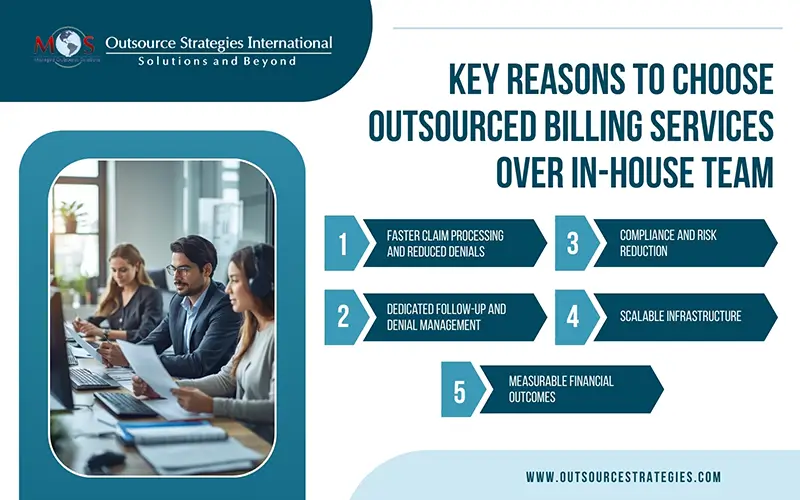
Outsourcing medical billing allows practices to replace fragmented, manual workflows with streamlined, specialized revenue cycle operations. Unlike internal teams that must divide their attention between multiple administrative responsibilities, external agencies operate with dedicated billing specialists whose sole focus is claim accuracy, payer compliance, and reimbursement optimization. This specialization directly improves first-pass acceptance rates and reduces the volume of rejected or underpaid claims.
- Faster Claim Processing and Reduced Denials
External claims management services utilize automated coding tools and real-time eligibility verification systems to identify missing or incorrect information before claims are submitted. This proactive review minimizes coding errors, documentation gaps, and payer-specific rule violations that commonly result in denials. By improving clean claim rates, practices experience faster reimbursement cycles and more predictable revenue flow. - Dedicated Follow-up and Denial Management
Third-party revenue cycle management assigns dedicated accounts receivable specialists to monitor unpaid and underpaid claims continuously. These teams conduct consistent follow-ups with payers, correct claim discrepancies, and resubmit claims promptly to prevent accounts from aging. This structured approach improves recovery rates and significantly reduces write-offs caused by delayed or neglected claims. - Compliance and Risk Reduction
Outsourced RCM teams invest heavily in ongoing coder training, certification programs, and compliance monitoring to remain aligned with evolving CPT, ICD, and payer policy updates. This reduces exposure to compliance violations, audits, and penalties. Practices benefit from increased coding accuracy and decreased risk of reimbursement delays caused by outdated billing practices. - Scalable Infrastructure
As patient volumes fluctuate or service lines expand, specialized providers of medical revenue cycle management can adjust resources accordingly without disrupting operations. This scalability eliminates the need for internal hiring, retraining, or overtime expenses while ensuring consistent RCM performance during periods of growth or seasonal demand. - Measurable Financial Outcomes
By improving claim accuracy, follow-up consistency, and compliance reliability, external teams deliver measurable financial benefits, including reduced days in accounts receivable, increased collection percentages, lower denial rates, and improved cash flow predictability. These improvements allow practices to allocate resources more effectively in operations, staffing, and patient care while maintaining long-term financial stability.
Internal revenue operations were once viewed as a practical solution but growing administrative complexity and reimbursement pressure have changed the operational standard. Practices that rely on fragmented, manual processes risk limiting cash flow consistency and long-term financial control. A professionally managed revenue cycle workflow provides the structure, accountability, and scalability needed to protect revenue performance and support sustainable growth.
Streamline Claims, Improve Collections, and Free Your Staff from Billing Burden

More from This Author