
Cybersecurity is a critical priority for healthcare organizations in today’s digital environment. HIPAA rules for medical billing govern eligibility checks, authorizations, claims, remittances, and other electronic transactions. In 2026, the HHS Office for Civil Rights (OCR) has increased its focus on patient Right of Access to billing records and the growing use of AI in medical coding and billing.
As of December 9, 2024, healthcare data breaches reported to the OCR impacted more than 168 million individuals—a record-breaking figure. Notably, nine of the 10 largest breaches were caused by hacking or IT-related failures, with several traced back to compromised HIPAA business associate network servers, including third-party vendors such as billing service providers. This highlights the critical need for every medical billing outsourcing company to strengthen HIPAA compliance, data security protocols, and risk management strategies to protect sensitive patient information.
This guide to HIPAA compliance in medical billing for 2026 covers the four core HIPAA rules, practical compliance strategies, common violations to avoid, and emerging regulatory trends impacting the healthcare revenue cycle.
Maximize reimbursement with our HIPAA-compliant medical billing services
Common HIPAA Violations in Medical Billing
A HIPAA medical billing violation occurs when protected health information (PHI) is improperly accessed, used, disclosed, or safeguarded during billing, coding, claims processing, or revenue cycle activities. A violation may be deliberate or unintentional. Common examples include:
- Unauthorized Access to Patient Data: Allowing employees or third parties to view PHI without a legitimate job-related purpose violates the HIPAA Privacy Rule.
- Improper Disclosure of PHI: Sharing patient information with insurers, vendors, or other parties without proper authorization or a valid Business Associate Agreement (BAA) is a violation.
- Failure to Implement Security Safeguards: Not using encryption, secure login credentials, access controls, or firewalls to protect electronic health records (EHRs) and billing systems breaches the HIPAA Security Rule.
- Lack of Minimum Necessary Compliance: Accessing or transmitting more patient data than required for billing purposes violates HIPAA’s Minimum Necessary Standard.
- Inadequate Staff Training: Failure to train billing staff on HIPAA policies and data protection practices increases compliance risk and may result in violations.
- Mishandling Paper Records: Leaving printed claims, EOBs, or patient statements unattended or improperly disposing of documents can lead to PHI exposure.
- Delayed or Missing Breach Reporting: Not reporting data breaches to affected patients and the HHS Office for Civil Rights within required timelines is also considered a HIPAA violation.
HIPAA violation penalties can range from under $200 to nearly $70,000 per violation, with multi-million-dollar annual caps for serious compliance failures. Four tiers are used for the penalty structure:
Tier 1 Unaware/Could not have known
Tier 2 Reasonable Cause (not neglect)
Tier 3 Willful Neglect (corrected in 30 days)
Tier 4 Willful Neglect (not corrected)
How to Stay HIPAA Compliant in Medical Billing for 2026
Understand the Four Pillars of HIPAA in Medical Billing
There are four specific HIPAA rules for medical billing that govern how billing departments handle patient data:
- The Privacy Rule: The Privacy Rule focuses on the “Minimum Necessary” standard under HIPAA, which means billing staff should only access the least amount of Protected Health Information (PHI) needed to process claims, such as diagnosis and procedure codes and insurance information — not the patient’s entire clinical history or the physician’s notes. Access is tied to a specific job function like claim submission, and not care coordination.
- The Security Rule: The Security Rule mandates administrative, physical, and technical safeguards to protect patients’ ePHI (electronic Protected Health Information) from threats, breaches, and unauthorized access:
- ePHI Protection: Safeguarding electronic data (diagnoses, SSNs, financial info) used in claims, payments, and operations.
- Administrative safeguards: Policies, training, and security management, like employee training on HIPAA and risk analysis.
- Physical safeguards: Securing physical access to systems (e.g., locked server rooms, device security).
- Technical safeguards: Implementing technology like 256-bit AES encryption, access controls (passwords/logins), and audit controls.
- The Breach Notification Rule: This HIPAA rule requires covered entities (providers, health plans, and medical billing companies) to notify patients when their unsecured PHI is breached in a way that compromises the privacy and security of the PHI. In 2026, timelines are stricter. Any breach must be reported to affected individuals and the HHS within 60 days (though some 2026 guidance suggests a move toward even shorter windows for major breaches).
- The Enforcement Rule: In medical billing, the HIPAA Enforcement Rule is the framework by the OCR to penalize violations of patient privacy (PHI). It establishes fines (Civil Money Penalties), investigations, and corrective actions for healthcare providers, insurers, and their business associates (like billing services) to ensure secure handling of patient data. The HSS Office for Civil Rights (OCR) enforces HIPAA through the four-tier penalty system which categorizes violations based on the level of culpability and whether the violation was corrected in a timely manner.
Implement Practical Steps to Stay Compliant
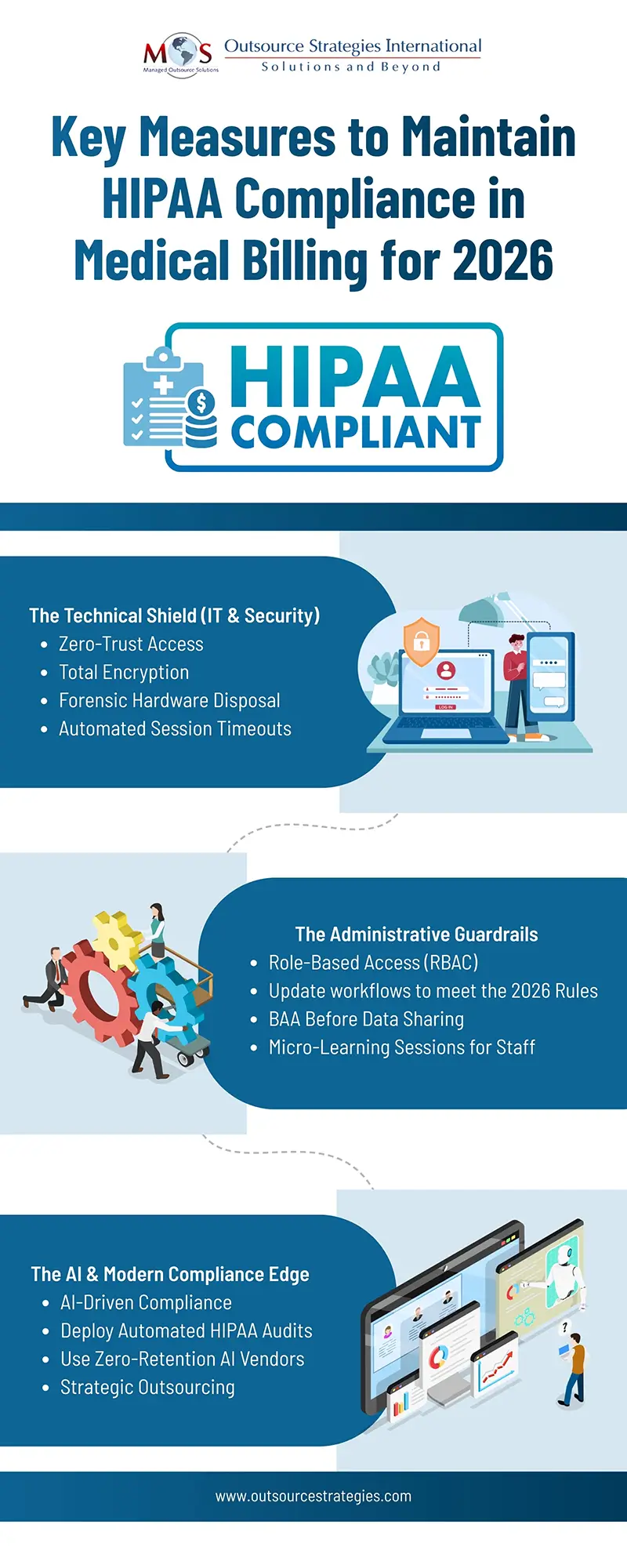
Implement daily “on-the-ground” technical, administrative and physical safeguards for HIPAA compliance:
Technical Safeguards
- Zero-Trust Access: Beyond simple passwords, set up Adaptive Multi-Factor Authentication (MFA) that flags logins from unusual locations or devices.
- End-to-End Encryption: Ensure ePHI is encrypted both “at rest” (stored in the database) and “in transit” (sent to clearinghouses).
- Automatic Log-offs: Set workstations to lock after 5–10 minutes of inactivity to prevent unauthorized viewing in shared office spaces.
Administrative & Physical Safeguards
- Business Associate Agreement (BAA): Healthcare providers must sign a BAA with every vendor that accesses their data, including cloud storage, clearinghouses, and IT consultants.
- Annual Risk Analysis: Conduct a formal audit at least once a year to identify new vulnerabilities in your billing software or workflow.
- Workstation Security: Protect billing screens from public view or unauthorized staff. Use privacy filters on monitors.
How to Avoid HIPAA Violations and Penalties
In 2026, the OCR has shifted from “educational warnings” to a “fine-first” mentality regarding common billing mistakes. Here is the detailed breakdown of these high-risk areas and how to bridge the gap between vulnerability and compliance.
- Unauthorized Access (Snooping)
Snooping remains a top cause of HIPAA violations, often involving billing staff checking the records of high-profile neighbors, celebrities, or others.
The solution: Implement strict Role-Based Access Control (RBAC) and avoid giving “General Admin” access to all users. Configure your billing software so that the payment posting section can see account balances but not clinical pathology reports. Use Automated HIPAA audits to flag irregular access of records (such as of a high profile patient) by a staff member.
- Improper Disposal of PHI
Using standard blue recycling bin to dispose a medical day sheet or donating an old laptop without forensic cleaning can lead to six-figure penalties. Identity thieves often search trash containers and hard drives for sensitive information.
The solution: Establish certified shredding & “kill-disk” protocols. Contract with a NAID-certified shredding service that provides a “Certificate of Destruction. Ensure that no hardware leaves the facility until it has undergone a wipe or shredding.
- Unsecured Communication
Standard email and SMS are inherently unprotected protocols. Sending a patient’s Social Security Number or a diagnostic code via Gmail or a personal iPhone is a direct violation of the HIPAA Security Rule. Hackers can intercept unencrypted data as it travels across the internet.
The solution: Ensure all patient communications are done on a HIPAA-compliant secure portal where users must log in to view messages. For email, use end-to-end encryption extensions that ensure the data is unreadable to anyone but the intended recipient. Always include a mandatory HIPAA confidentiality disclaimer in the footer.
- Right of Access Failures
The most significant regulatory shift in 2026 is the clampdown on “information blocking.” Patients have more power than ever to demand their data, and the OCR is using this as a primary enforcement tool. Under the 2026 updated rules, the deadline to provide records has been reduced from 30 days to 15 days.
The solution: Create a Dedicated “Right of Access” workflow, specifically focusing on timely access to billing records. Automate the request process so that the system automatically timestamp the patient’s requests for their records via your portal. Set a 10-day internal alert to ensure the 15-day legal deadline is never missed.
- Rise of AI-Driven Billing
In the age of AI and stricter OCR enforcement, going by standard procedures for billing compliance can pose a risk.
Solution: Implement AI-driven billing compliance. Use AI to catch “upcoding” or “unbundling” before submission. AI prioritizes which claims to appeal based on the highest probability of success. Ensure the human-in-the-loop requirement is met: AI results must be audited human billing experts.
HIPAA Compliance: In-House vs. Outsourced Medical Billing
In-house medical billing teams operate as part of a healthcare organization’s workforce and do not require BAAs, but must still follow HIPAA standards such as the Minimum Necessary Rule and secure communication practices.
HIPAA requirements for outsourcing medical billing to business associates are different from that for in-house billing. Outsourced medical billing providers are classified as HIPAA business associates and must have a Business Associate Agreement in place before handling PHI. Outsourcing helps smaller practices reduce staffing costs while ensuring claims are generated, reviewed, and submitted in compliance with payer requirements.
Protect Your Practice with Expert Support
In 2026, complying with HIPAA rules for medical billing is no longer just about avoiding fines—it’s about protecting the heartbeat of your practice: patient trust. By mastering the “Right of Access” timelines and embracing the precision of AI-driven tools, you transform compliance from a legal burden into a strategic advantage.
For many growing practices, managing these high-tech safeguards and shifting rules in-house can be overwhelming. This is where outsourcing medical billing to a HIPAA-certified partner becomes a game-changer. A dedicated partner provides built-in security, automated audits, and the expertise needed to ensure your revenue cycle remains both profitable and fully protected against the evolving landscape of 2026.
Outsource medical billing to our HIPAA-trained billing team
Stay compliant, focus on patient care.

More from This Author