

Reimbursement delays rarely originate at the payer level. They begin earlier, in the gap between clinical documentation and the code assigned to represent it. Medical coding denials rank among the top five most preventable causes of rejected submissions, according to Experian Health’s Denial Management survey. More than 40% of providers now report that at least one in ten submissions is denied. This trend has worsened year over year. Strong denial management depends on catching these errors before they reach the payer, not after. AI-driven platforms are changing where intervention happens, shifting from post-rejection correction to early, upstream detection of the underlying coding gap.
Why Medical Coding Denials Keep Rising
Several forces are converging to drive denial rates upward in 2026. Code sets expand every year. Payer rules shift without warning. Coder shortages strain internal review capacity. Each factor compounds the others, creating conditions where even well-trained staff struggle to catch every error before submission.
Documentation gaps remain the most persistent driver. Clinical notes often lack the specificity that current code sets demand. A missing comorbidity, an unclear severity level, or an undocumented complication can each trigger a rejection. Payer policy volatility adds further pressure. Coverage rules change across commercial plans, Medicare Advantage, and Medicaid programs at a pace that manual tracking cannot reliably match.
Staffing shortages compound both issues. Fewer experienced coders are available to catch errors that automated edits alone cannot detect. When review capacity shrinks while submission volume grows, the probability of an error reaching the payer increases proportionally. The result is a widening gap between what providers intend to submit and what payers are willing to accept.
Struggling with rising denial rates and lost revenue?
Get expert coding support today.
The Financial Weight of Preventable Coding Errors
The cost of an individual denial extends well beyond the lost reimbursement. Reworking a single rejected submission costs between $25 and $181, depending on complexity and payer requirements. At scale, this expense compounds quickly. A mid-sized hospital averaging 2,000 denials per month can spend close to $3 million annually on correction and resubmission alone, before accounting for revenue that is never recovered.
Permanent loss is the more damaging consequence. A significant share of denied submissions are never resubmitted, converting a delay into a write-off. For organizations operating on thin margins, this pattern accumulates into a material drag on annual revenue that persists independent of how strong the underlying clinical care delivery may be. Proactive denial management is therefore not just an operational concern; it is a financial imperative.
AI-Powered Medical Coding: Catching Errors Before They Become Denials
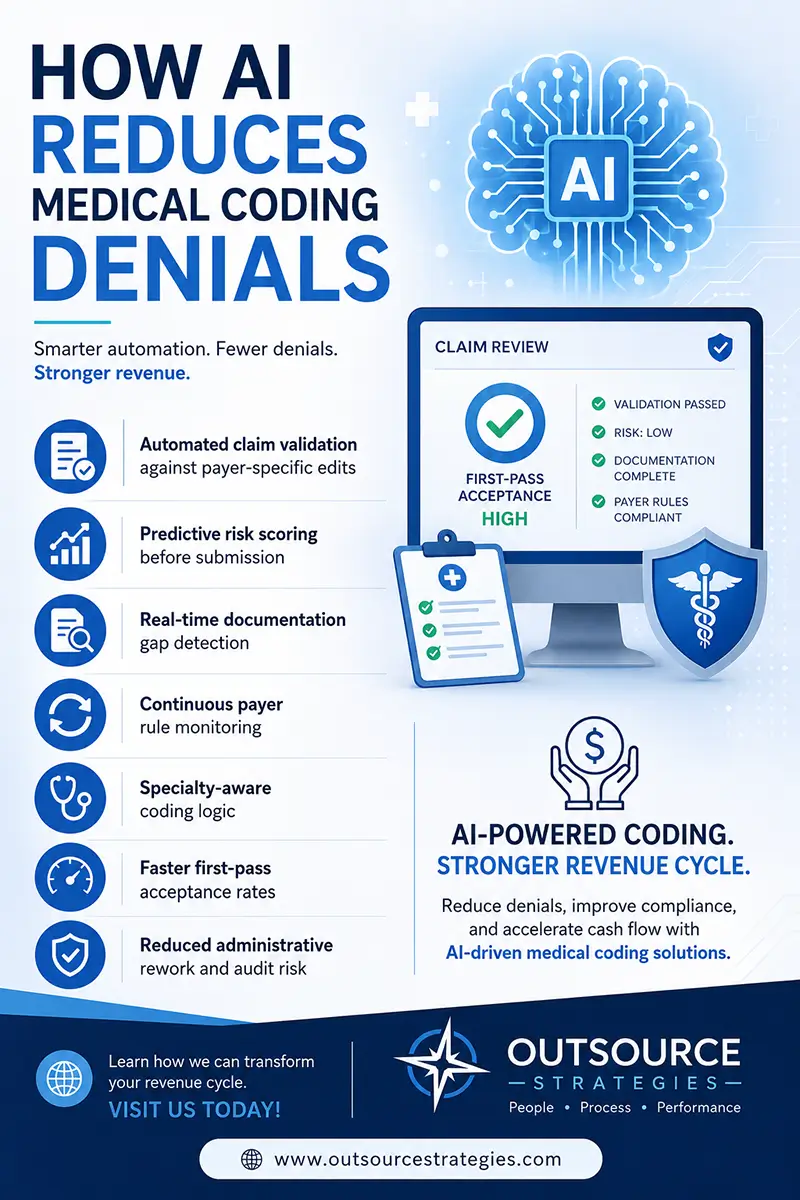
AI-powered medical coding intervenes at the point where errors originate, before a payer has already rejected the claim. This shift in timing is the central distinction between automated and manual review models. Manual review is episodic and volume-constrained; AI validation is continuous, consistent, and scales with submission volume without degradation in thoroughness.
Automated Claim Validation
AI-enabled scrubbing tools cross-reference every code assignment against current payer-specific edits, NCCI rules, and Local Coverage Determinations before submission. Errors in modifier usage, code pairing, and bundling logic are flagged immediately. They no longer surface weeks later in a remittance advice. This validation layer applies the same scrutiny to every submission regardless of volume, eliminating the inconsistency that comes with manual review fatigue.
Predictive Analytics for Risk Scoring
Machine learning models analyze historical denial patterns by payer, code category, and clinical specialty. Each new submission receives a risk score before it leaves the organization. High-risk submissions are routed for human review, while low-risk cases proceed through automated validation. This prioritization concentrates staff attention where it produces the greatest return, rather than distributing review effort evenly across every claim.
Real-time Documentation Gap Detection
Many coding errors trace back to clinical notes that lack the detail current payer requirements demand. AI-driven gap detection tools identify these deficiencies as documentation is created, prompting clarification before a coder ever assigns a code. Addressing the gap at its source prevents the costly cascade of denial, appeal, and resubmission that follows from a single missed clinical detail. This is particularly valuable in high-acuity settings where documentation complexity is greatest.
Continuous Payer Rule Monitoring
Payer policies change frequently and often without advance notice. AI-powered medical coding platforms absorb these updates automatically, applying the most current edits the moment they take effect. This eliminates the lag that occurs when staff must manually track and implement each policy revision across multiple payer relationships, a lag that is one of the most common sources of avoidable denials.
MedGenX: Specialty-Aware Denial Prevention
Platforms such as MedGenX, powered by DeepKnit AI, apply AI-driven logic to validate clinical documentation. The platform checks coding rules, payer-specific edits, and compliance guidelines before a submission is finalized. The platform’s gap resolution capability flags missing or insufficient documentation at the point of coding. This addresses the root cause of denials rather than managing their aftermath.
MedGenX adapts its validation logic to the specific requirements of each clinical specialty rather than applying a single generalized model. This matters because denial patterns vary significantly across practice areas. Oncology submissions require precise linkage between diagnostic findings and treatment protocols. Orthopedic claims involve complex modifier rules and global period requirements. Cardiology and radiology each carry their own layered payer requirements around medical necessity documentation. A specialty-aware platform recognizes these distinctions and applies the corresponding validation logic automatically.
Denial Management Improvements Through Proactive Review
Effective denial management has shifted from a retrospective recovery function to a proactive prevention discipline. Organizations that integrate AI-driven validation into their coding workflow report measurably stronger first-pass acceptance rates. Most preventable errors are now caught before submission rather than after rejection.
This shift changes how revenue cycle teams allocate their time. Staff previously focused on reworking denied submissions now redirect that effort toward exception handling and complex case review, the work that genuinely requires clinical judgment. The result is not simply fewer denials. It is a more efficient distribution of human expertise across the claims that genuinely require clinical judgment.
Engaging AI powered medical billing and coding services gives organizations a clear advantage: automated validation handles the routine, while experienced compliance oversight manages the complex. The combination delivers both the speed of continuous review and the judgment that edge cases still demand.
How Denial Patterns Signal Audit Risk
Recurring coding denials rarely stay isolated. Payers and regulators increasingly treat denial frequency as a signal worth investigating further. The Office of Inspector General and commercial payers both use claims data analytics to flag organizations whose denial rates deviate from peer benchmarks.
A pattern of repeated denials in the same code category often precedes a targeted audit request. Most facilities maintain a general accuracy rate between 94% and 96%, but targeted code-over-code targeted reviews frequently expose a different picture, since this method evaluates each individual code rather than scoring an entire record as correct or incorrect. This gap exists because targeted reviews focus narrowly on the specific codes tied to known denial trends, while routine audits sample more broadly across a record.
Organizations that resolve denial patterns early reduce more than rework costs. They also reduce the likelihood of attracting payer or regulatory scrutiny tied to those same patterns. AI-driven trend analysis supports this by surfacing recurring denial categories before they accumulate into an audit trigger, giving compliance teams the opportunity to correct systemic documentation habits proactively.
Compliance teams that monitor denial trends by code category gain an early warning system rather than a retrospective report. This visibility allows organizations to correct documentation habits before a pattern hardens into a recurring liability across multiple payers and reporting periods.
FAQs
What causes most medical coding denials?
Documentation gaps, code mismatches, and eligibility errors rank among the top preventable causes of denied submissions. Payer policy changes and coder shortages further compound the problem. Incomplete or non-specific clinical documentation is consistently the most difficult to correct after the fact, which is why upstream gap detection has become a critical component of effective denial management.
How does AI prevent denials before claim submission?
AI-driven platforms validate code assignments against payer-specific edits and compliance rules at the point of coding rather than after rejection. Predictive risk scoring flags high-risk submissions for human review before they leave the organization, while continuous payer rule monitoring ensures that the latest coverage requirements are applied to every claim.
Can AI replace human coders in denial prevention?
AI redistributes coder effort rather than replacing it. Routine, low-risk submissions are validated automatically, while staff focus on complex cases and exception review that require clinical judgment. AI powered medical billing and coding services are most effective when they operate as a complement to experienced coders, not a substitute for them.
Does AI-powered coding work across all medical specialties?
Specialty-aware platforms adapt their validation logic to the distinct documentation patterns and payer requirements of each clinical area. This precision matters because denial drivers vary significantly between specialties. A single generalized model cannot reliably address the nuanced requirements that differ between oncology, orthopedics, cardiology, and other high-complexity practice areas.
How quickly can AI-driven denial prevention show results?
Organizations typically see measurable improvement in first-pass acceptance rates within the first few months of integration. Results scale further as the platform absorbs more payer-specific data and denial patterns over time. Early gains are usually most visible in high-volume, high-denial specialties where the baseline error rate gives AI validation the most room to improve.
Prevention Before Submission Is the Standard Going Forward
Medical coding denials are not an unavoidable cost of high-volume claim processing. They are a measurable, addressable failure that occurs when documentation gaps and coding errors go undetected until a payer rejects the submission. AI powered medical coding moves the point of intervention earlier in the workflow through predictive risk scoring, real-time documentation gap detection, and continuous payer rule monitoring. Correction at this stage is faster, less costly, and far less disruptive to the revenue cycle.
Organizations that adopt this proactive model position themselves for stronger first-pass acceptance rates, faster reimbursement cycles, and a measurably lower risk of audit exposure. As coding complexity and payer scrutiny continue to grow, the distinction between automated and manual review models will become an increasingly decisive factor in sustained revenue cycle performance.
Reduce denials and strengthen revenue cycle performance with proven coding expertise.

More from This Author