
Medical coding is rapidly evolving with generative AI, automation, and predictive analytics streamlining workflows and addressing manual coding challenges. As healthcare organizations face growing documentation demands, complex payer rules, and staffing shortages, AI-medical coding platforms like MedGenX are helping improve coding accuracy, compliance, and claim turnaround times through advanced automation supported by human expertise. The future of medical coding is moving toward smarter, predictive, and specialty-focused solutions.
Improve coding accuracy and reduce denials with AI-powered medical coding.
Let’s break down how medical coding with generative AI models like MedGenX works and where it’s headed.
How Generative AI Is Reshaping Medical Coding
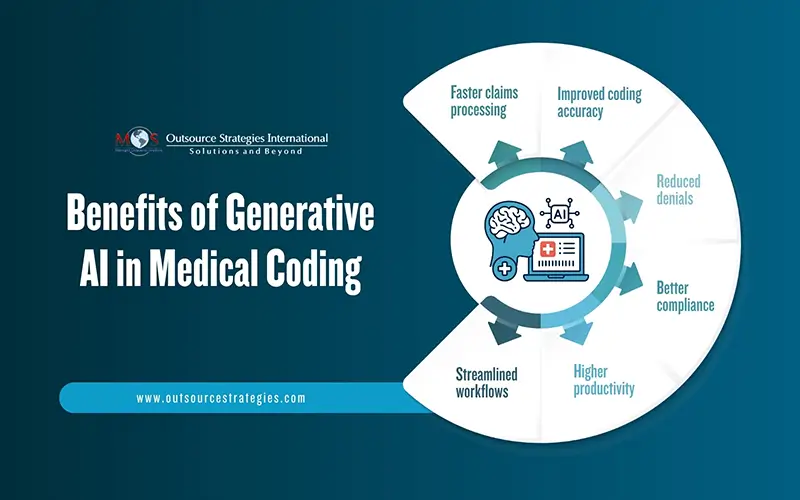
Generative AI is changing how medical records are analyzed and translated into standardized medical codes. Unlike traditional rule-based automation, MedGenX can understand clinical context, interpret physician notes, summarize documentation, and recommend accurate ICD-10, CPT, and HCPCS codes.
This AI-powered coding system can:
- Analyze unstructured clinical documentation
MedGenX uses generative AI and advanced natural language processing (NLP) to analyze unstructured clinical documentation such as physician notes, operative reports, discharge summaries, and radiology interpretations. By extracting relevant clinical details from free-text records, the platform helps convert complex documentation into actionable coding insights, improving coding accuracy and overall healthcare revenue cycle management (RCM).
- Suggest codes based on medical context
Beyond relying solely on keyword recognition, MedGenX interprets the clinical context of patient encounters to recommend appropriate ICD-10, CPT, and HCPCS codes. This contextual understanding helps support more accurate code selection for complex conditions and procedures while reducing the risk of coding inconsistencies. Specialty-specific AI medical coding models can handle the unique documentation and complex procedures of various specialties, from primary care, radiology, pathology, anesthesia, and surgery to complex/niche specialties such as oncology, cardiology and orthopedics.
- Detect missing or incomplete documentation
This AI-powered platform helps identify documentation gaps that may affect coding accuracy, medical necessity validation, or claim reimbursement. It flags incomplete diagnoses, missing procedural details, unspecified laterality, and other documentation deficiencies that can lead to payer denials or compliance issues.
- Flag potential compliance risks
MedGenX supports coding compliance and audit readiness by detecting potential issues such as upcoding, unbundling, modifier misuse, and documentation-code mismatches. By identifying these risks before claim submission, the platform helps healthcare organizations strengthen regulatory compliance and reduce audit exposure.
- Support real-time coding assistance with EHR integration
The platform integrates with electronic health records to provide real-time coding support. It helps coders and providers identify the documentation needed for accurate code selection as they work. Instant coding suggestions and smart prompts help improve specificity, minimize back-and-forth queries, and speed up the claims submission process.
- Reduce repetitive manual tasks
By automating repetitive coding functions such as chart review, code lookup, documentation analysis, and claim validation, the platform helps reduce administrative burden on coding teams. This allows coders to focus more on complex cases, quality assurance, and compliance review rather than time-consuming manual processes.Healthcare workflow automation with generative AI helps coders process high volumes of claims more efficiently while reducing human error. However, large language models (LLMs) still require human oversight for rare or complex cases.
Significance of Human-in-the-Loop Medical Coding
Even as AI medical coding technology continues to advance, human expertise remains essential. Medical coding requires clinical judgment, understanding of payer-specific guidelines, and knowledge of changing regulations. AI cannot completely replace experienced coders in these areas.
Across studies, reviewers consistently emphasize the importance of human verification, audit trails, and specialty-specific rollouts to ensure reliability and compliance. Here are key findings highlighting the value of the human-in-the-loop approach:
- Coder AI collaboration, such as prioritized code suggestions and interactive correction loops reduces workload while maintaining accuracy. The study emphasizes designing AI systems to support human coders rather than replace them (NPJ Digit Med. 2024).
- Artificial intelligence in healthcare documentation improves clarity and reduces coder ambiguity, but manual coder review remains a vital quality control step (Perspect Health Inf Manag. 2024).
- Regulators and healthcare organizations increasingly favor AI models with human oversight, explainability, and clear auditability (NEJM AI, 2023).
Despite a MarketsandMarkets report highlighting massive growth in the global healthcare AI space, complete automation faces limitations. The future points toward a hybrid model where generative AI handles routine coding tasks while experienced coding professionals ensure accuracy and compliance.
The key benefits of integrating AI with human expertise are:
- Increased coding accuracy and productivity
- Reduced claim rework and denials
- Improved turnaround time and cash flow
- Better compliance with CMS and payer regulations
- Scalability for high-volume claims processing
The Future of Medical Coding: Other Expectations
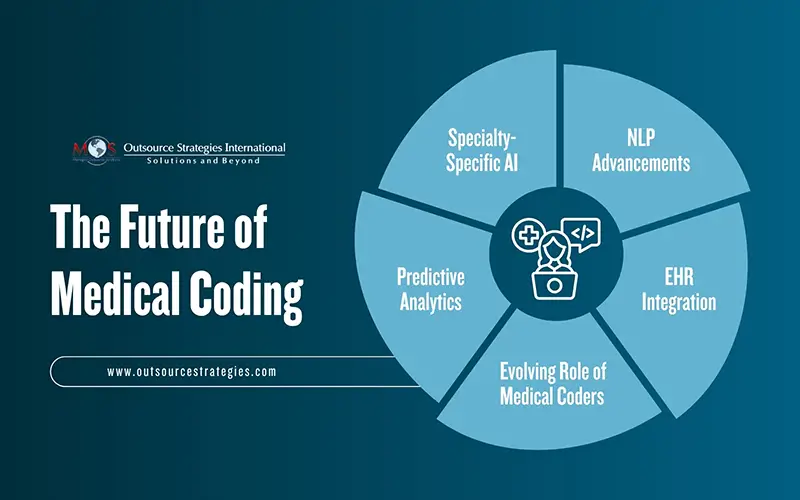
In addition to the transition of human coders into more advanced auditing, quality assurance, and compliance-focused roles, the future of AI medical coding is expected to bring the following changes:
Predictive Analytics Will Improve RCM
Future coding platforms will not only assign codes but also predict claim outcomes. AI-driven predictive analytics can identify coding inconsistencies, claims likely to be denied, documentation gaps, etc.
Real-Time Coding Assistance Will Become Standard
The future of medical coding includes real-time AI assistance integrated directly into electronic health records (EHRs). Physicians may receive instant prompts during documentation to improve specificity and support accurate coding. Examples include: prompting for laterality, requesting missing diagnosis details, and suggesting additional documentation for medical necessity
NLP Will Continue to Advance
NLP is becoming more sophisticated in understanding medical terminology, abbreviations, and clinical context. Future NLP systems will better interpret physician dictations, operative reports, radiology notes, discharge summaries, and telehealth documentation.
Specialty-Specific AI Coding Solutions will Grow
Medical specialties have unique coding complexities. Future AI systems will become increasingly specialty-focused. Specialty-smart AI can help improve coding accuracy for complex cases in orthopedics, cardiology, and other fields to meet evolving payer requirements.
Strengthened Compliance and Audit Readiness
Healthcare organizations face constant scrutiny related to coding accuracy and fraud prevention. Intelligent medical coding platforms will support stronger compliance by monitoring coding patterns, detecting potential fraud risks, identifying upcoding or unbundling issues, etc.
The Role of Medical Coders Will Evolve
Industry experts see the role of coders as evolving to remain highly competitive in this automated landscape. Certified coders will collaborate with clinical leaders to manage risk adjustment models (such as Hierarchical Condition Categories, or HCC), ensuring quality metrics match patient complexity. They will increasingly function as:
- AI validators and reviewers
- Documentation quality specialists
- Compliance auditors
- Denial prevention experts
- Revenue integrity analysts
Continuous training and upskilling will become increasingly important as coding technology evolves.
Building a Smarter Future for Medical Coding and Billing
The future of medical coding points toward a hybrid model where generative AI handles routine coding tasks while experienced coding professionals ensure accuracy and compliance. The combination of AI medical coding efficiency and human judgment creates a strong, compliant, and future-ready RCM workflow, ensuring billing and coding accuracy, faster reimbursement, regulatory compliance, and optimized financial performance.
Streamline claims processing with AI medical coding and expert support.

More from This Author