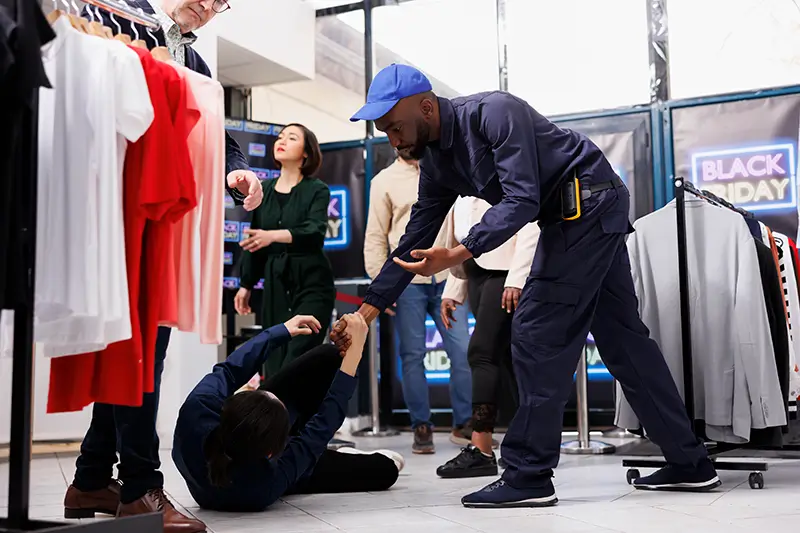
Officially opening the Christmas shopping season, Black Friday follows Thanksgiving Day in the U.S. With hundreds of attractive deals and discounts available, Black Friday starts and ends on Nov. 23. Some stores offer discounts for the entire week, day, or even a few hours, and some are open even during midnight. A survey by the National Retail Federation found that 174 million US consumers went shopping online or in-store last year over the Thanksgiving weekend. But what role do emergency rooms (ERs) and ambulance services have on this day? Along with its excitement to nab the latest gifts or gadgets at a discount, Black Friday often leads to shopping injuries, including fatalities. ER staff needs to be on the alert to treat these traumas. Physicians can rely on the medical coding services provided by reliable companies to report these injuries correctly on claims and obtain appropriate optimal reimbursement.
Black Friday shopping can become unruly, leading to trampled shoppers, bruised brawlers, and people injured in parking lots. Even while driving, many shoppers tend to focus on their bargain goals rather than the pedestrians around them. Pedestrian accidents often need immediate medical attention to ensure that injuries do not get worse.
Even though shopping-related injuries are not just limited to Black Friday, several reports highlight this as a day which witnesses an increased number of injuries. According to blackfridaydeathcount.com, since 2006, 111 people have been injured and 10 deaths occurred nationally during Black Friday. The most common injuries that occur on Black Friday are parking lot injuries, stampede and shopping cart injuries, and injuries caused by falling boxes, and fights. Massive traffic jams and over-crowded sidewalks also lead to accidents.
Accurate ICD-10 medical coding is critical to ensure proper billing for claims related to injuries occurring on the biggest shopping day of the year. Some of the diagnostic codes that ER physicians may report are:
- V02.00 Pedestrian on foot injured in collision with two- or three-wheeled motor vehicle in non-traffic accident
- V06.00XA Pedestrian on foot injured in collision with other non-motor vehicle in non-traffic accident, initial encounter
- W01.0 Fall on same level from slipping, tripping and stumbling without subsequent striking against object
- W01.1 Fall on same level from slipping, tripping and stumbling with subsequent striking against object
- W03 Other fall on same level due to collision with another person W20 Struck by thrown, projected or falling object
- W10 Fall on and from stairs and steps
- W10.0XXA Fall (on)(from) escalator, initial encounter
- W17.82 Fall from (out of) grocery cart
- W22.8XXA Striking against or struck by other objects, initial encounter
- W52.XXXA Crushed, pushed or stepped on by crowd or human stampede, initial encounter
- Y04.0XXA Assault by unarmed brawl or fight, initial encounter
- Y92.481 Parking lot as the place of occurrence of the external cause
- Y92.59 Other trade areas as the place of occurrence of the external cause
Store owners should take extra steps to prevent any dangers that could cause injury on their property. Retailers should also follow crowd control guidelines issued by OSHA. Emergency room medical coding can be made easy by partnering with an experienced medical billing and coding company.

More from This Author