
Accurate drug reimbursement depends on precise coding, and that is where J-codes in medical billing play a critical role. J-codes are a subset of the Healthcare Common Procedure Coding System (HCPCS) Level II, used to report injectable drugs, biologics, and certain infused medications administered in clinical settings. Without the correct J-code on a claim, payers cannot determine what was administered, at what dose, or whether reimbursement is warranted. Providers that rely on professional medical billing services understand that J-code accuracy is not optional. It is foundational to clean claim submission and revenue cycle performance.
What Are J-Codes and How Are They Structured?
J-codes are alphanumeric HCPCS Level II codes that begin with the letter “J,” followed by four numeric digits. For example, J1745 (infliximab injection, 10 mg) or J9041 (doxorubicin hydrochloride injection, 10 mg). Each code corresponds to a specific drug or biological product and carries embedded information such as the drug name, dosage unit, and route of administration.
These codes are maintained and updated by the Centers for Medicare and Medicaid Services (CMS). They are used to bill medications not typically self-administered. These are drugs that require clinical supervision, such as intravenous infusions, subcutaneous injections, or intramuscular administrations. J-codes span the range J0120 to J9999 and cover categories from antibiotics and immunoglobulins to chemotherapy agents and monoclonal antibodies.
The structure of a J-code entry typically includes:
- Drug name: The exact medication or biological product being reported
- Dosage unit: The quantity each unit of the code represents (e.g., per 10 mg, per vial)
- Route of administration: Intravenous, subcutaneous, or intramuscular, where applicable
- Description: A concise summary of the drug’s formulation or strength
Are you struggling with the complexities of medical billing and coding?
We can help!
Common J-Code Categories in Medical Billing
J-codes span a wide range of drug categories. The following table provides an overview of the primary categories and representative code examples used across clinical specialties.
| Category | Code Example | Drug / Description |
|---|---|---|
| Chemotherapy agents | J9041 | Doxorubicin hydrochloride injection, 10 mg |
| Biologics / Monoclonal antibodies | J1745 | Infliximab injection, 10 mg |
| Immunoglobulins | J1459 | Immune globulin, intravenous, non-lyophilized |
| Antibiotics | J0696 | Ceftriaxone sodium injection, 250 mg |
| Pain management agents | J2001 | Lidocaine HCl injection, 10 mg |
| Hormonal agents | J1950 | Leuprolide acetate injection, per 3.75 mg |
| Anti-anemia drugs | J0881 | Epoetin alfa injection, per 1,000 units |
| Unclassified medications | J3490 | Unclassified drugs (no permanent J-code assigned) |
Specialties that rely most heavily on J-codes include oncology, rheumatology, ophthalmology, pain management, and infusion therapy centers. Any clinical setting where drugs are prepared and administered in-house, rather than dispensed to patients for home use, operates within J-code territory.
J-Codes in Medical Billing: Key Compliance Requirements
National Drug Code (NDC) Reporting
CMS and most commercial payers require the NDC to accompany J-code submissions on outpatient claims. The NDC links the billed drug to its specific manufacturer, dosage form, and package size. Missing NDC data is one of the leading causes of outpatient claim rejections. Coders must include the drug’s NDC, the dose administered, and the route of administration on every applicable claim.
Billing Units and Dosage Accuracy
Each J-code is defined by a specific unit of measure, typically per milligram, per vial, or per specific dose increment. Billing units must align precisely with the dose documented in the clinical record. Billing units must align precisely with the dose documented in the clinical record. Payers use automated edits to flag unit mismatches immediately, resulting in denials without manual review.
Modifier Usage: JW and JZ
CMS mandates the use of waste modifiers for single-dose container drugs under Medicare Part B. The rules are as follows:
- Modifier JW: Applied when a portion of a single-dose vial is discarded. A separate claim line is required to report the wasted units.
- Modifier JZ: Applied when no drug is wasted, confirming full utilization of the vial. Effective July 1, 2023, all claims for single-dose containers must carry either JW or JZ. Claims without either modifier are automatically rejected by Medicare without human review.
These two modifiers are mutually exclusive and cannot appear on the same claim line for the same drug. Missing modifier JZ is currently the leading cause of claim rejections in this category.
J-Codes vs. CPT Codes
A common source of billing errors is conflating J-codes with CPT codes. The distinction is critical:
- J-codes identify the drug product: what was administered and at what dose
- CPT codes identify the procedure: how the drug was administered (e.g., 96413 for first-hour chemotherapy infusion; 96372 for a therapeutic injection)
Both code sets must appear on a claim for drug administration services. J-codes alone do not convey the clinical service; CPT codes alone do not identify the drug. Omitting either results in a denied or improperly reimbursed claim.
Specialty-specific Considerations
Oncology
Chemotherapy drug codes fall within the J9000–J9999 range under HCPCS Level II. CMS separates chemotherapy administration CPT codes (96401–96549) from non-chemotherapy infusion codes, and this distinction directly affects reimbursement under the Hospital Outpatient Prospective Payment System (HOPPS). Anti-anemia and anti-emetic drugs given during cancer treatment are not classified as chemotherapy administration. This distinction generates significant audit attention. Coders must verify drug classification before selecting administration codes.
Rheumatology and Immunology
Biologic therapies for autoimmune conditions, such as infliximab (J1745) and other monoclonal antibodies, carry high per-unit costs, making unit accuracy critical. Payers scrutinize these claims closely, and improper unit reporting can trigger both payment recovery and OIG audit activity.
Ophthalmology
Intravitreal injections represent one of the highest-volume J-code billing scenarios. A May 2025 OIG audit found that Medicare paid $313 million for 3.3 million intravitreal injections. For 42% of those injections, providers billed E/M services on the same day using modifier 25, with $124 million in associated payments flagged as at risk for noncompliance. This highlights the compliance risk when administration codes are mismatched with drug codes.
How AI Is Transforming J-Code Accuracy
J-code assignment is among the more error-prone tasks in outpatient coding. The combination of dosage-unit specificity, modifier requirements, NDC reporting, payer-level variation, and frequent CMS quarterly updates creates significant room for human error.
AI-powered coding platforms are addressing this challenge directly. Platforms such as MedGenX, powered by DeepKnit AI, apply AI-driven coding logic to interpret clinical documentation and assign accurate HCPCS codes, including J-codes, based on the documented drug, dose, and administration method. The platform cross-references CMS guidelines, payer-specific rules, and LCD/NCCI edits before finalizing code assignments, reducing the risk of unit mismatches and missing modifiers.
The AI-assisted workflow also includes documentation gap analysis. When clinical notes lack the specificity needed to determine the correct dosage unit or administration route, the platform flags the gap and prompts resolution before claim submission. This prevents the downstream denial that would otherwise result.
For high-volume infusion centers and specialty practices dealing with expensive biologics, an AI-enabled approach to drug code assignment is not just an efficiency tool. It is a compliance safeguard.
Best Practices for Accurate J-Code Submission
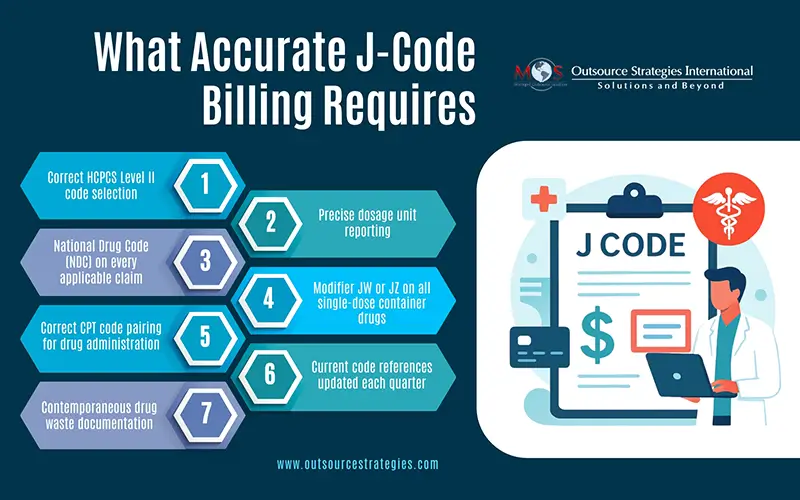
Healthcare providers and their coding teams should follow these practices to reduce denials and maintain compliance:
- Verify drug classification before coding: Confirm whether the drug falls under a chemotherapy, biologic, or standard injectable category. Each has distinct CPT pairing requirements.
- Use the most current HCPCS code set: CMS updates J-codes quarterly. Relying on outdated code references is a direct path to claim rejection.
- Include NDC data on every applicable claim: Pair each J-code with the correct NDC, unit of measure, and route of administration.
- Apply JW or JZ modifiers on all single-dose container claims: Never leave the modifier field blank for Medicare Part B single-dose drug submissions.
- Pair J-codes with correct CPT administration codes: Always submit the procedure code alongside the drug code to represent both the service and the product.
- Document drug waste contemporaneously: Record the exact dose administered and the amount wasted in the patient’s chart at the time of service, not retrospectively.
- Conduct periodic coding audits: Regular internal reviews of J-code submissions identify patterns of unit miscalculation or modifier omissions before they become audit targets.
Professional medical coding services that specialize in drug billing can provide the expertise needed to manage these requirements consistently, particularly as payer policies and CMS guidelines continue to evolve.
Why J-Code Accuracy Cannot Be Overlooked
J-codes in medical billing serve as the standardized language through which injectable drugs, biologics, and infused therapies are communicated to payers for reimbursement. Their precision requirements, spanning dosage units, NDC reporting, waste modifiers, and CPT pairing, make them one of the more technically demanding areas of outpatient coding. Errors are not merely administrative oversights; they translate directly into denied claims, compliance exposure, and revenue loss. Healthcare providers that invest in rigorous coding protocols, current code references, and AI-assisted platforms position themselves for cleaner claims, faster reimbursement cycles, and reduced audit risk. Engaging qualified medical billing services and medical coding services ensures that J-codes in medical billing are applied with the specificity, compliance awareness, and clinical context that accurate drug reimbursement demands.
Streamline your medical billing and coding processes and focus on care!

More from This Author