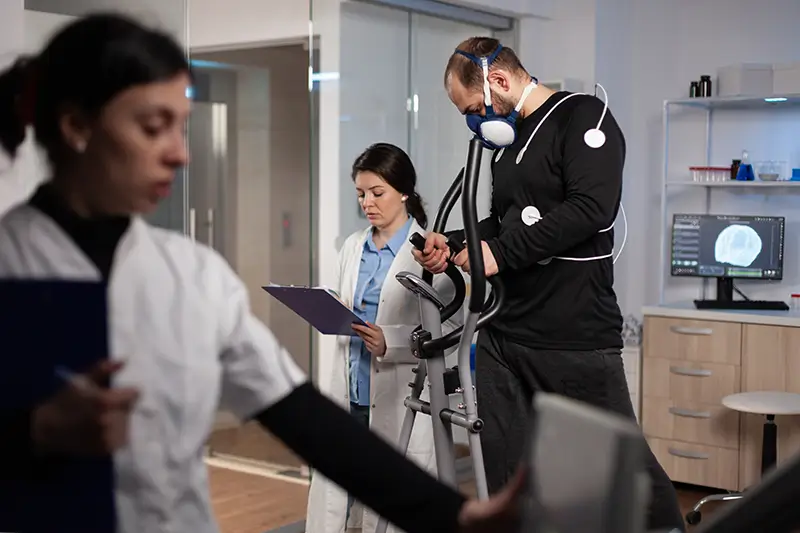
Treadmill stress testing is a diagnostic test that uses treadmill bicycle and helps physicians to check how well their patient’s heart handles the work and whether the blood supply is reduced in the arteries that supply blood to the heart. This cardiovascular exercise stress testing along with ECG has been very crucial for the diagnosis and prognosis of cardiovascular diseases, especially coronary artery disease (CAD). The test helps evaluate a patient for exercise related arrhythmias or hemodynamic changes, and/or cardiac functional capacity for heart transplant patients. Medical coding for cardiac stress test is sometimes confusing for at least some healthcare providers as well as medical coding services. This is mainly associated with three components of cardiac stress testing – technical component, supervision and interpretation.
When reporting treadmill stress testing, you should use the relevant CPT codes as well as the relevant ICD codes to show medical necessity. Here are the 2015 CPT codes for these procedures and applicable diagnostic codes.
CPT Codes
- 93015: Cardiovascular stress test using maximal or submaximal treadmill or bicycle exercise, continuous electrocardiographic monitoring, and/or pharmacological stress: with supervision, interpretation and report
- 93016: Cardiovascular stress test using maximal or submaximal treadmill or bicycle exercise, continuous electrocardiographic monitoring, and/or pharmacological stress: supervision only, without interpretation and report
- 93017: Cardiovascular stress test using maximal or submaximal treadmill or bicycle exercise, continuous electrocardiographic monitoring, and/or pharmacological stress: tracing only, without interpretation and report
- 93018: Cardiovascular stress test using maximal or submaximal treadmill or bicycle exercise, continuous electrocardiographic monitoring, and/or pharmacological stress: interpretation and report only
Applicable ICD-9 Codes
- 410: Acute myocardial infarction
- 413: Angina pectoris
- 424.1: Aortic valve disorders
- 427.5: Cardiac arrest
- 429.2: Cardiovascular disease, unspecified
- 786.5: Chest pain, unspecified
- 426: Conduction disorders
- 746.86: Congenital heart block
- 746.85: Coronary artery anomaly
- 429.4: Functional disturbances following cardiac surgery
- 394.0: Mitral Stenosis
- 412: MI (myocardial infarction), old
- 429.1: Myocardial degeneration
- 411: Other acute and subacute forms of ischemic heart disease
- 414: Other forms of chronic ischemic heart disease
- 416.0: Primary pulmonary hypertension
- 395.0: Rheumatic aortic stenosis
You should find out whether your patient’s carrier still accepts ICD-9 codes. If not, you should map all these codes into their corresponding ICD-10 medical codes. For example, in the case of coronary atherosclerosis of native coronary artery (other forms of chronic ischemic heart disease), you can find one code in ICD-9 and four corresponding codes in ICD-10. You should assign the most appropriate one according to the patient’s condition.
ICD-9
- 414.01: Coronary atherosclerosis of native coronary artery
ICD-10-CM
- I25.110: Atherosclerotic heart disease of native coronary artery with unstable angina pectoris
- I25.111: Atherosclerotic heart disease of native coronary artery with angina pectoris with documented spasm
- I25.118: Atherosclerotic heart disease of native coronary artery with other forms of angina pectoris
- I25.119: Atherosclerotic heart disease of native coronary artery with unspecified angina pectoris
The code 93015 is used for reporting the complete cardiac stress test procedure that includes all the three components and it is reportable only by a physician in a non-facility setting (for example, office, clinic or diagnostic testing center). If a complete procedure is not performed, codes 93016-93018 are reported by the various providers depending on the specific procedures actually performed. In a facility setting (for example, hospital), technical portion of the service is reported by the facility and the applicable component codes (93016 and 93018) are reported by the physician. The physician should be very careful about reporting only those components of the stress test actually provided.

More from This Author