
Medicare Part B covers medically necessary physical therapy (PT) services in outpatient settings, reimbursing providers through the Medicare Physician Fee Schedule (MPFS). Beginning in 2026, Medicare policy updates will affect reimbursement, documentation, supervision requirements, telehealth services, and compliance obligations. Understanding these changes is essential for maintaining accurate billing, minimizing denials, and optimizing revenue cycle performance.
This post breaks down how the 2026 Medicare policy changes impact physical therapy medical billing and reimbursement, and outlines what providers must do to stay compliant and financially successful under the new rules.
Note: The Medicare policy changes discussed below primarily affect physical therapy services billed under Medicare Part B, including outpatient rehabilitation, private practice physical therapy, telehealth, and remote therapeutic (RT) monitoring services.
Medicare Compliance Updates for Physical Therapy Medical Billing 2026
- Physical Therapy Reimbursement Updates
- Review Medicare Part B reimbursement changes for your highest-volume CPT codes.
- Conduct a payer-impact analysis to identify services affected by RVU adjustments.
- Monitor cash flow and revenue projections based on expected Medicare payment changes.
- Evaluate opportunities to participate in value-based care and Alternative Payment Models (APMs).
CMS increased the Medicare Physician Fee Schedule (MPFS) conversion factor for 2026, and most physical therapists are expected to see an average payment increase of about 1.75%.
However, reimbursement changes will vary by service because CMS also updates the Relative Value Units (RVUs) assigned to individual CPT codes. As a result, some therapy services may receive higher reimbursement while others may experience little change or even payment reductions.
Action Steps
- KX Modifier Threshold
- Document why continued therapy remains medically necessary.
- Record objective measures such as pain scores, range of motion, strength testing, gait assessments, and functional outcome measures.
- Update treatment goals and patient progress regularly.
- Clearly explain why ongoing therapy is expected to improve or maintain function.
- Ensure documentation supports all billed CPT codes and treatment minutes.
For 2026, the Medicare KX modifier threshold for outpatient therapy services is $2,480.
Medicare Part B uses the KX modifier billing code to attest that PT services exceeding the annual threshold are medically necessary. In 2026, claims submitted for services above the $2,480 threshold without the KX modifier will be automatically denied by Medicare.
KX Modifier Requirements for Physical Therapy 2026: Action Steps
- Manual Medical Review Threshold
- Notes must clearly explain why a specific service, test, or treatment was essential for that individual patient.
- Make sure clinicians and billing staff recognize warning signs, such as unusually high costs, billing patterns, or frequent use of the KX modifier.
The Medicare Manual Medical Review (MR) threshold is a specific spending limit established for outpatient therapy services. For CY 2026, the Medicare targeted manual medical review threshold is $3,000.
While the $3,000 threshold does not automatically trigger a medical review, claims exceeding this amount may be selected for Targeted Probe and Educate (TPE) review based on CMS risk-analysis criteria.
Action Step: Maintain Audit-Ready Documentation
Beyond reporting the correct diagnoses codes, practices must maintain audit-ready documentation to avoid compliance issues.
- Supervision Rules
- Services furnished by PTAs remain subject to the CQ modifier and the PTA payment differential (the CQ modifier is the Medicare billing code used to indicate that an outpatient PT service was provided in whole or in part by a PTA).
- Practices should ensure billing systems accurately append the CQ modifier when required.
- Documentation should clearly identify which services were provided by the PT and which were furnished by the PTA.
- State practice acts may impose stricter supervision requirements than Medicare.
Beginning January 1, 2025, CMS clarified supervision requirements for outpatient therapy services, including physical, occupational, and speech therapy. CMS now allows general supervision of physical therapy assistants (PTAs) in private practice settings under Medicare Part B. Under general supervision, the PT does not need to be physically present during treatment.
Key Implications for PT Billing
Private practices may consider adjusting staffing models to optimize therapist and PTA utilization.
- Telehealth Updates
- Verify that the service is included on Medicare’s approved telehealth list.
- Ensure documentation supports medical necessity and delivery of virtual physical therapy services.
- Use the correct POS code and modifier based on CMS guidance.
- Monitor payer-specific telehealth policies because commercial insurers may have different requirements.
Under the Final Rule, PTs, OTs, and SLPs can bill for Medicare telehealth services, including the telephone assessment and management services (codes 98966 – 98968) through December 31, 2027.
Remote Therapeutic Monitoring (RTM) continues to provide physical therapists with opportunities to generate reimbursement for monitoring patient adherence, response to treatment, and therapeutic progress outside traditional clinic visits. CMS added 3 new RTM codes (98979, 98984, 98985 and revised 2 existing RTM codes (98976 and 98977).
Billing RTM Services in Physical Therapy Practices: Key Considerations
- Exception to the Plan of Care Certification Requirement
- The referral/order is included in the patient’s medical record.
- The therapist submits the plan of care to the referring provider within 30 days of the initial evaluation.
- Documentation shows that the plan of care was transmitted to the referring provider.
- Reduced administrative workload associated with obtaining physician signatures.
- Faster claim submission and fewer delays in the revenue cycle.
- Lower risk of payment delays caused solely by missing physician signatures.
- Increased importance of documenting referral orders and proof that the plan of care was sent within the required timeframe.
CMS has introduced an important exception to the physician signature requirement for initial certification that reduces administrative burden for physical therapy practices. Under this exception, therapists no longer need to obtain and track a signed plan of care from the referring provider in certain referral-based cases.
Effective for services provided on or after January 1, 2025, a signed and dated physician or nonphysician practitioner referral/order can satisfy the initial certification requirement if:
If the provider does not respond with changes or objections after receiving the plan of care, Medicare considers the certification requirement satisfied.
Billing Implications for PT Practices
Practices must continue to maintain complete documentation and comply with all other Medicare therapy coverage, medical necessity, and certification requirements.
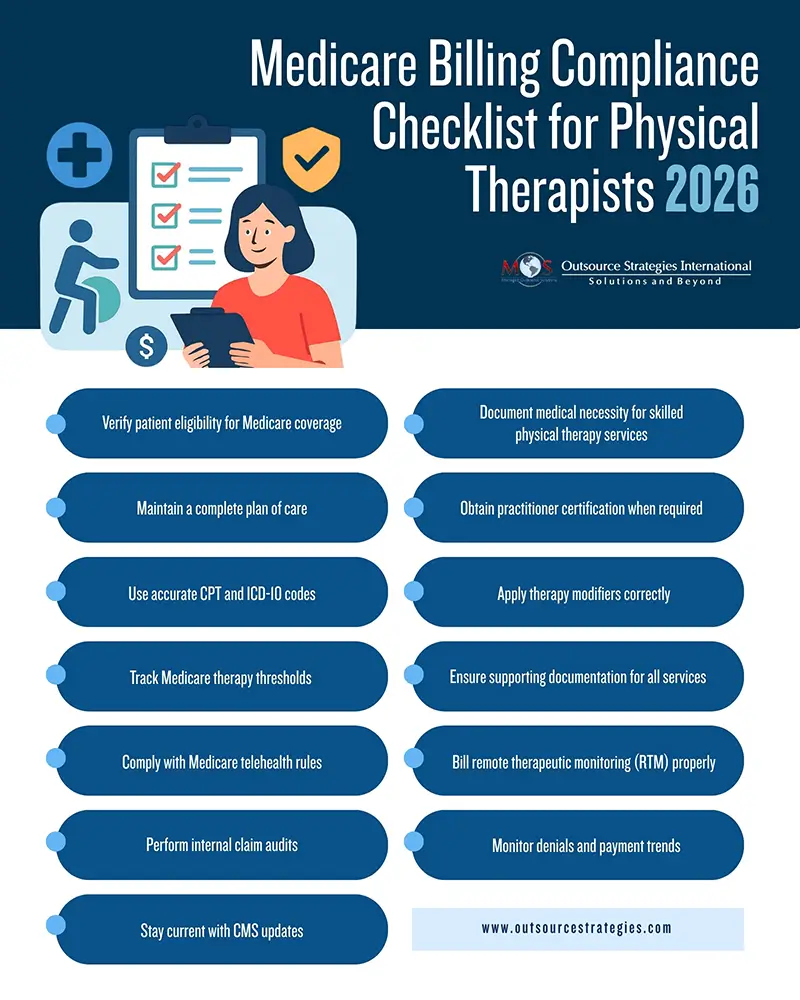
Key Takeaways: How 2026 Medicare Policy Changes Impact Physical Therapy Medical Billing
Medicare payments for therapy services depend on strict coding and documentation rules, requiring therapists to track treatment times and manage payment thresholds carefully to avoid denied claims.
The 2026 Medicare updates present both opportunities and compliance challenges for physical therapy practices. While reimbursement is expected to increase modestly overall, success will depend on accurate coding, proper modifier usage, strong documentation, and proactive monitoring of CMS policy changes.
The key to thriving under Medicare’s 2026 rules is combining excellent patient care with strong billing and compliance processes. By partnering with an experienced physical therapy medical billing company, practices can meet Medicare documentation requirements for physical therapy claims, align their billing processes with evolving regulations. This helps boost claim accuracy and maximize collections in the increasingly challenging healthcare reimbursement reform environment.
Improve reimbursement and reduce denials with our expert physical therapy medical billing services.
FAQs
What are the major Medicare billing changes affecting physical therapy practices in 2026?
Key Medicare updates for 2026 include reimbursement adjustments under the Medicare Physician Fee Schedule, continued requirements for accurate documentation of medical necessity, therapy threshold monitoring, proper use of modifiers, and evolving policies related to telehealth and Remote Therapeutic Monitoring (RTM) services.
Why is Medicare regulatory compliance essential for physical therapy practices?
Medicare policy changes can affect reimbursement rates, documentation requirements, coding guidelines, and claim submission processes. Physical therapy practices must stay current with CMS regulations to ensure legitimate billing, prevent fraud and abuse, minimize claim denials and optimize revenue.
What documentation is required for Medicare physical therapy claims?
Physical therapists must maintain detailed records that support medical necessity, treatment goals, patient progress, skilled interventions provided, and the plan of care. Complete documentation is essential for claim approval and audit readiness.
What is the KX modifier, and when should physical therapists use it?
The KX modifier is used when therapy services exceed the annual Medicare therapy threshold and the provider has documentation demonstrating that continued treatment remains medically necessary.
Why is accurate coding important for Medicare physical therapy billing?
Accurate CPT and ICD-10 coding ensures that services are billed correctly and supported by documentation. Coding errors can lead to claim denials, payment delays, audits, and lost revenue. AI medical coding with a human-in-loop approach can be particularly valuable to meet increasingly complex Medicare billing and documentation requirements.
Are telehealth physical therapy services covered by Medicare in 2026?
Medicare continues to allow coverage for certain telehealth services, subject to CMS regulations. Physical therapy practices should verify current eligibility, documentation, codes, and billing requirements before submitting telehealth claims.
How can physical therapy practices reduce Medicare claim denials?
Practices can reduce denials by verifying patient eligibility, documenting medical necessity thoroughly, using correct codes and modifiers, monitoring therapy thresholds, and conducting regular billing audits.
What is Remote Therapeutic Monitoring (RTM) and how does it affect billing?
RTM allows providers to monitor patients remotely using approved technologies and bill for qualifying monitoring and management activities. Accurate documentation and compliance with Medicare requirements are necessary for reimbursement.
How often should physical therapy practices review Medicare billing policies?
Practices should review Medicare updates at least annually and whenever CMS releases new guidance. Regular staff training helps ensure compliance with changing billing and reimbursement requirements.
What are the most common Medicare billing mistakes made by physical therapy practices?
Common errors include insufficient documentation, incorrect CPT or ICD-10 coding, improper modifier usage, failure to verify eligibility, overlooking therapy thresholds, and submitting incomplete claims.
Partnering with an experienced physical therapy medical billing company can help practices stay current with Medicare regulations, improve coding accuracy, ensure proper documentation, denials, and optimize reimbursement.

More from This Author