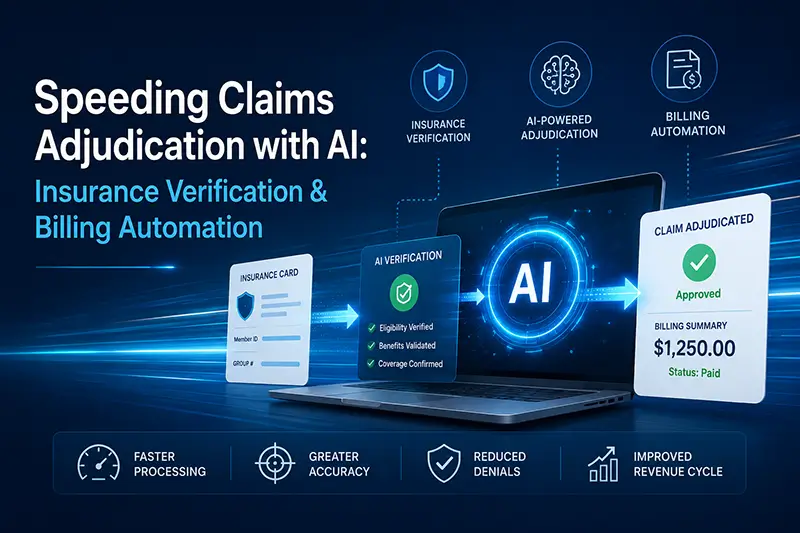
Insurance verification confirms a patient’s eligibility and coverage before services are provided. When performed manually, it can be time-consuming, requiring staff to review patient demographics, policy details, coverage limits, and exclusions. Accurate verification supports clean claims submission, after which the insurer adjudicates the claim to determine reimbursement eligibility. AI is transforming this process by eliminating manual verification delays and accelerating claims adjudication by automatically extracting data and instantly validating coverage.
This post breaks down the challenges of the health insurance eligibility verification, and how AI for insurance verification and billing automation speeds claims adjudication.
Eliminate coverage surprises and reduce claim denials with accurate, timely insurance eligibility verification services.
Challenges of Rising Claim Denials and Slow Adjudication
Rising claim denials and slow adjudication remain significant challenges in medical billing, resulting in cash flow disruptions and increasing administrative burdens for providers. Recent analyses found that approximately one in five healthcare claims are denied, with many denials caused by administrative issues such as incomplete documentation, coding errors, and eligibility problems. According to recent industry data, insurers denied about 20% of claims in 2024, highlighting the growing need for more efficient claims management processes.
As payer requirements become more complex, healthcare organizations are increasingly adopting AI-powered insurance verification and billing automation solutions to improve claim accuracy, reduce denials, and accelerate reimbursement cycles.
Understanding Claims Adjudication in Insurance
Claims adjudication is the structured review process that health insurance companies use to review submitted medical claim. The goal is to determine whether the claim is valid, meets policy coverage limits, and complies with all billing guidelines. This evaluation determines how much the insurance will pay or whether the claim will be denied.
Understanding the claims adjudication process helps healthcare providers submit cleaner, more accurate claims, reducing the likelihood of rejections and denials while improving reimbursement outcomes. For patients, it clarifies how insurance companies determine whether a treatment, service, or procedure is covered and what costs they may be responsible for.
Key steps in the claims adjudication process:
- Submission: The healthcare provider submits a claim to the insurance payer with details of the services rendered.
- Validation: The payer reviews the claim to ensure all required information is complete, accurate, and properly formatted.
- Verification: The insurer applies payment policies and coverage rules to determine benefit eligibility, and whether prior authorization was obtained for services that require it. Coverage dates, procedure codes and benefit limits are validated to ensure alignment with the patient’s health plan.
- Medical necessity review: Reviewing the medical necessity for higher-cost treatments prevents unnecessary or inappropriate healthcare utilization.
- Processing: The claim is evaluated against payer policies, coding guidelines, and contract terms and submission timeframes to determine reimbursement.
- Payment/Denial: The payer either approves the claim for payment, partially reimburses it, or denies it with an explanation of the reason.
Claims that fail these checks are flagged for manual review or returned for correction. Healthcare providers can appeal denied claims by submitting additional information within the insurer’s specified timeframe.
Claims processing automation for physician practices streamlines the submission, validation, and adjudication of medical claims, reducing administrative workload, minimizing errors, speeding up reimbursements, and improving overall revenue cycle performance.
Challenges of Traditional Workflows
To understand how AI speeds up claims adjudication in healthcare, let’s first break down the challenges of manual processes. Traditional workflows are slow and often inefficient, leading to errors and challenges in insurance verification and billing:
- High administrative workload: Staff spend days on billing, coding, and claims-related tasks, reducing operational efficiency.
- Time-consuming manual eligibility checks: Verifying patient coverage manually delays scheduling, billing, and claims submission processes.
- Fragmented EHR, billing, and payer portals: Disconnected systems make it difficult to access and share accurate information across the revenue cycle.
- Frequent claim rejections and resubmissions: Errors and missing information often result in denied claims that require costly rework and follow-up.
- Regulatory and compliance complexity: Constantly evolving payer rules and healthcare regulations increase the risk of billing errors and noncompliance.
Role of AI in Healthcare Revenue Cycle Management and Claims Adjudication
AI-powered insurance verification speeds up claims adjudication by automatically extracting data and instantly validating coverage.
Instant Data Extraction
Advanced Optical Character Recognition (OCR) and Natural Language Processing (NLP) instantly capture details from IDs and policies. Machine learning algorithms scan for policy anomalies, such as recent coverage changes or lapses, flagging them immediately. By improving data accuracy at intake stage, AI reduces risk of errors in the billing and claims adjudication process.
Automated Insurance Eligibility Verification
AI tools automatically cross-check submitted claim details against active coverage dates, deductibles, and specific exclusions. AI performs real-time eligibility checks, instantly verifying a patient’s insurance status, benefits, copays, deductibles, and coverage details before services are provided. Using AI for insurance verification confirms whether specific procedures, treatments, or services are covered under the patient’s health plan, helping to prevent eligibility-related billing errors and claim denials.
Billing Automation
Automating billing processes using AI, robotic process automation (RPA), and other workflow tools streamline billing tasks, and reduce manual effort, and improves claim accuracy. AI-powered medical coding tools assign accurate medical codes based on clinical documentation, reducing coding errors and improving billing accuracy. AI claim scrubbing using NCCI and payer-specific edits prevents coding errors, missing information, and compliance issues before submission, reducing rejections and accelerating reimbursement.
Predictive Analytics
AI analyzes previous claims and billing data to identify patterns, predict potential denials, prioritize high-risk claims, and support proactive revenue cycle management.
Ultimately, AI-driven billing efficiency and accuracy reduces claim denials and rework, resulting in faster reimbursement cycles.
Benefits of AI in Claims Adjudication
AI-powered insurance verification and billing can improve claims adjudication by accelerating processing, reducing denials, and increasing claim accuracy:
- Faster claims processing turnaround: By automating routine tasks, AI accelerates claim reviews, reduces adjudication times and speeds up reimbursements.
- Reduced administrative costs: Automation minimizes manual effort, allowing staff to focus on higher-value activities while lowering operational expenses.
- Improved accuracy and compliance: AI helps identify coding errors, missing information, and compliance issues before claims are submitted.
- Lower denial rates: By validating eligibility, coverage, and claim details upfront, AI reduces the chances of rejections and denials.
- Enhanced patient and provider experience: Faster claim resolution, improved billing accuracy, and better transparency drive higher satisfaction for both patients and healthcare providers.
Investing in modern technology helps healthcare providers manage complex billing processes, reduce revenue leakage and avoid claim denials and adjudication delays.
Implementing AI for Insurance Verification and Billing
As claim denials continue to rise and adjudication processes become increasingly complex, healthcare organizations need smarter, more efficient ways to manage their revenue cycles. AI-powered health insurance eligibility verification and billing automation can help reduce manual workloads, improve claim accuracy, accelerate adjudication, and minimize costly denials. However, achieving these benefits requires the right expertise, technology, and workflow strategies. Partnering with an experienced healthcare revenue cycle management company can help organizations implement effective automation solutions that also combine human expertise to streamline claims management, improve reimbursement outcomes, and maintain compliance in the evolving healthcare landscape.
Maximize revenue, accelerate reimbursements, and strengthen financial performance with expert healthcare RCM solutions.

More from This Author