
Healthcare fraud takes many forms, but few carry consequences as severe as phantom billing. It refers to the submission of claims for services that were never performed, equipment that was never delivered, or patient encounters that never took place. Every year, fraudulent claim submissions drain federal health programs of billions of dollars, expose providers to criminal prosecution, and erode patient trust.
For medical practices operating in an environment of intensifying enforcement activity, understanding how phantom billing works and what internal safeguards prevent it is not optional. It is a compliance imperative. Engaging professional medical billing services with proven compliance protocols is one of the most direct steps a practice can take to reduce this risk.
What Phantom Billing Looks Like in Practice
Phantom billing is not always the result of deliberate, large-scale fraud. It surfaces in multiple forms, some intentional and some the result of inadequate documentation controls. Common patterns include:
- Non-rendered services: A provider submits a claim for a consultation, diagnostic test, or procedure that the patient never received
- Cancelled appointments billed as completed visits: A patient misses a scheduled appointment, but the encounter is coded and submitted as if it occurred
- Phantom patients: Claims submitted under real patient identifiers for individuals who have no record of receiving care
- Duplicate billing with altered dates: The same service is billed more than once with modified dates of service to avoid automated duplicate edits
- Unbilled supplies or equipment: Durable medical equipment or prescription items billed to insurers but never dispensed to the patient
As Amy Jenkins, Clinical Assistant Professor in Health Systems and Population Health at the University of Washington School of Public Health, notes, phantom billing “is the act of submitting claims for patient services that didn’t actually happen,” and the False Claims Act specifically prohibits it. Whether the submission is deliberate or the result of poor internal controls, the legal exposure is the same.
The Scale of the Problem in 2026
Enforcement data from 2025 and 2026 illustrates the scale and urgency of this issue. The DOJ’s 2025 National Health Care Fraud Takedown, the largest in the department’s history, resulted in criminal charges against 324 defendants, including 96 licensed medical professionals, across 50 federal districts. The alleged intended loss exceeded $14.6 billion, more than doubling the previous record of $6 billion.
Phantom billing was explicitly cited among the fraud categories driving this enforcement action. The DOJ confirmed that the schemes spanned Medicare, Medicaid, and other federal health programs. In parallel, the False Claims Act generated a record $6.8 billion in recoveries in fiscal year 2025, with healthcare accounting for $5.7 billion of that total.
The CMS Fiscal Year 2025 Improper Payments Fact Sheet reported a Medicare Fee-for-Service improper payment rate of 6.55%, representing $28.83 billion. While not all improper payments constitute fraud, the figures signal the scale of claim integrity failures across the system.
Concerned about fraudulent claim submissions draining practice revenue?
Get expert compliance support today.
Legal Consequences Practices Cannot Afford to Ignore
Phantom billing violations carry both criminal and civil consequences under federal law. Under 18 U.S.C. § 1347, conviction for healthcare fraud carries a sentence of up to 10 years in federal prison per offense. If the fraud results in serious bodily injury, that sentence increases to 20 years.
On the civil side, the False Claims Act imposes per-claim penalties ranging from $14,308 to $28,619 per false submission, plus treble damages equal to three times the amount defrauded. Since each line item on a claim counts as a separate offense, a practice that submitted hundreds of fraudulent claims can face penalties in the millions.
Critically, the False Claims Act does not require proof of intent. Reckless disregard for billing accuracy, or a failure to verify claim accuracy, is sufficient to trigger liability. This means practices with weak documentation and review controls face exposure even in the absence of deliberate fraud.
Additional consequences include:
- Exclusion from Medicare and Medicaid: OIG has authority to exclude convicted providers from all federal health programs, effectively ending their ability to practice
- License revocation: State medical boards pursue disciplinary action independently of federal prosecution
- Reputational damage: Fraud investigations generate public records and media coverage that affect referral networks and patient trust
- Civil settlements: Providers under investigation frequently settle for amounts far exceeding the original billing discrepancy
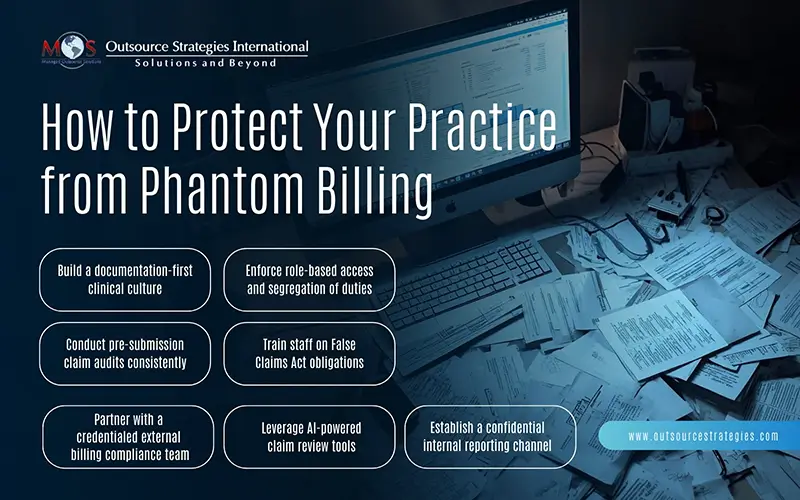
How to Protect Your Practice from Phantom Billing
Build a Documentation-first Culture
Every billable service must be supported by contemporaneous clinical documentation. This means provider notes must reflect the service before coding begins, not after. The documentation must capture:
- The date and time of the service
- The identity of the patient and treating provider
- The clinical reason for the service
- What was performed, observed, or assessed
- The outcome or follow-up plan
Backdated notes, template-generated records that do not reflect actual patient encounters, and unsigned documentation are audit triggers. Compliance programs must establish clear documentation standards and enforce them uniformly across all providers and staff.
Implement Pre-submission Claim Audits
Practices should conduct internal audits of claims before submission. A structured pre-submission review identifies:
- Claims submitted for dates when the patient did not attend
- Duplicate claim lines with modified service dates
- Codes that do not match the documented clinical encounter
- Missing signatures or unsigned orders
- Claims for services that lack corresponding orders or referrals
Audit frequency should increase in high-risk service areas such as infusion therapy, durable medical equipment, diagnostic testing, and telehealth. Practices that identify errors before submission can correct them without triggering payer scrutiny or compliance investigations.
Enforce Segregation of Duties
No single staff member should have unrestricted access to both clinical documentation and claim submission. Separating these functions reduces the risk of unilateral fraud. Access controls should be role-based, and any override or manual edit to a finalized claim should require supervisory approval and generate an audit trail.
Train Staff on Compliance Obligations Regularly
Billing and coding staff must understand what constitutes a fraudulent submission under the False Claims Act. Training should cover:
- The definition and examples of phantom billing
- Documentation requirements for commonly billed services
- The obligation to report suspected fraud internally
- Whistleblower protections under the False Claims Act
Annual training is insufficient in a rapidly evolving regulatory environment. Practices should conduct training at onboarding, after major payer policy changes, and following any internal audit finding.
Establish a Credible Internal Reporting Mechanism
Staff who witness or suspect fraudulent billing activity need a clearly defined, confidential channel for reporting concerns. Without such a mechanism, issues go unreported until they surface in an external audit or whistleblower complaint. A documented internal reporting process signals to staff that compliance is taken seriously, and it creates an opportunity to identify and correct problems before they escalate.
Protecting Practices from Phantom Billing: The Role of AI
Traditional fraud detection relied on retrospective audits, reviewing claims weeks or months after submission. By that point, payments had already been made and recoveries were difficult. AI-driven detection has fundamentally changed this model.
AI-powered platforms now analyze every claim at the point of submission, assigning risk scores based on hundreds of variables simultaneously. Machine learning models identify anomalies in billing patterns, deviations in service frequencies, and non-obvious patient visit overlaps. These are patterns that manual review processes cannot reliably detect across high claim volumes.
Natural language processing (NLP) adds a critical layer by comparing clinical notes against billed codes. NLP algorithms can identify inconsistencies between documentation and billed procedures, detect copied or template-generated notes that may indicate phantom encounters, and flag unusual language patterns that suggest fabricated documentation.
CMS has already moved in this direction. As part of the 2025 National Health Care Fraud Takedown, CMS reported that its real-time analytics and fraud prevention tools prevented over $4 billion in improper payments ahead of the enforcement action.
For practices seeking AI-assisted compliance support on the coding side, platforms such as MedGenX, powered by DeepKnit AI, apply AI-enabled coding logic to cross-reference clinical documentation against coding rules, payer policies, and compliance guidelines before claims are finalized. The platform’s interactive gap resolution capability flags documentation deficiencies that could result in unsupported claims, addressing one of the root causes of phantom billing risk at the coding level.
An AI-driven approach to claim review does not replace human oversight. It concentrates human review where risk is highest, reducing the volume of claims requiring manual scrutiny while improving the accuracy of fraud detection.
Why Phantom Billing Prevention Demands External Expertise
Internal compliance programs reduce risk but cannot eliminate it entirely. Practices face limitations in staff expertise, audit capacity, and knowledge of evolving payer policies. A qualified medical billing company brings certified coders, compliance officers, and structured audit workflows that practices cannot always replicate internally.
External billing partners provide:
- Independent claim review before submission
- Ongoing monitoring of payer policy changes and CMS updates
- Coding accuracy verification against current guidelines
- Structured documentation audits across all service lines
- Compliance reporting and escalation protocols
The White & Case 2025 FCA Enforcement Report recommends that healthcare providers replace retrospective audits with real-time analytics, validate documentation integrity, and audit billing practices proactively. These are capabilities that experienced external billing partners are positioned to provide.
Why No Practice Is Too Small to Be Targeted
A common misconception is that enforcement actions target only large hospital systems or organized fraud networks. The 2025 Takedown data dispels this. Among the 324 defendants charged were individual physicians, nurse practitioners, and pharmacists operating in private practice settings. Enforcement agencies use data analytics to identify statistical anomalies in billing patterns regardless of practice size. A small practice billing for services at volumes that deviate significantly from peer benchmarks will attract scrutiny. Size provides no protection.
Phantom Billing Has No Safe Harbor
Phantom billing remains one of the most aggressively prosecuted forms of healthcare fraud, and 2026 enforcement activity confirms that the regulatory environment is becoming more, not less, rigorous. The combination of AI-powered detection tools at CMS, record False Claims Act recoveries, and a whole-of-government enforcement approach means that practices with weak billing controls face elevated exposure. Protecting a practice requires more than good intentions. It requires documented protocols, trained staff, pre-submission audits, and technology-enabled oversight.
The practices that invest in these safeguards now are the ones that navigate audits without consequence. Those that do not are the ones that become enforcement statistics. Partnering with an experienced medical billing company that applies rigorous compliance standards at every stage of the claim lifecycle is among the most effective risk management decisions a practice can make in the current enforcement climate.
Strengthen billing compliance and protect the practice from costly fraud exposure.

More from This Author