
Most claim denials do not originate at the payer. They originate earlier, in the clinical record itself. According to Nym Health’s 2025 research, 37% of physician notes lack sufficient detail for optimal code assignment. The same research found that 82% of denied claims stem from inconsistencies between documentation and submitted codes. Tools built to detect documentation gaps before submission are changing how organizations approach this problem. Instead of waiting for a payer rejection to reveal a missing detail, AI-driven platforms flag the gap early. The record is still being created when the flag appears. AI Medical Coding Software now makes this kind of early intervention possible at scale.
Why Documentation Gaps Keep Generating Denials
Coders work only with what providers write. When a clinical record omits a key detail, a coder cannot assign the precise code the documentation does not support. This creates a structural mismatch between clinical reality and billing accuracy.
Several conditions drive this mismatch:
- Vague evaluation and management notes: Missing detail on complexity or medical decision-making leads to undercoding or denial
- Incomplete procedural detail: Modifiers require specific clinical context that brief notes often omit
- Nonspecific diagnoses: Conditions documented without laterality, severity, or acuity prevent accurate risk adjustment
- Missing attribution in collaborative care: Split or shared visits require clear documentation of each provider’s contribution
- Template-generated notes: Auto-populated fields can mask the absence of patient-specific clinical detail
Each of these patterns forces a coder to either query the provider or assign a less specific code. A query delays claim submission. A less specific code risks denial. Either path adds friction to the revenue cycle.
Struggling with documentation-related denials and lost revenue?
Get expert support today.
How AI Tools Detect Documentation Gaps Before Submission
Real-Time Natural Language Analysis
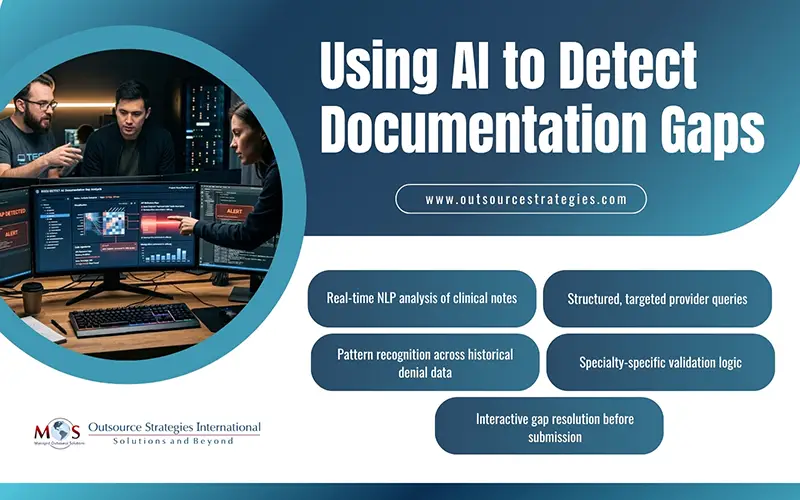
AI-enabled platforms read clinical notes as they are written. Natural language processing compares documented detail against the specificity required for accurate code assignment. This differs fundamentally from retrospective audit models. In those models, a gap is identified only after the encounter has closed. By then, the claim has already moved downstream.
Pattern Recognition Across Historical Denials
Machine learning models analyze prior denial data. This identifies which documentation patterns most frequently trigger rejections for a given specialty or payer. The system flags high-risk gaps with greater precision this way, rather than applying a single generic checklist to every encounter.
Structured Query Generation
When a gap is detected, AI-assisted tools generate a specific, targeted query for the provider. This differs from a generic clarification request. A focused query names the missing element directly. It gets resolved faster than an open-ended one, reducing the back-and-forth that typically delays claim finalization.
Specialty-Specific Validation
Documentation requirements vary significantly across clinical areas. Oncology notes require precise linkage between diagnostic findings and treatment protocols. Orthopedic records depend on laterality and procedural specificity. AI platforms trained on specialty-specific documentation patterns apply the corresponding validation logic automatically. They do not treat every encounter the same way.
This distinction extends to payer-specific requirements as well. A single specialty can face different documentation expectations across Medicare, Medicare Advantage, and commercial plans. Validation logic that accounts for both clinical specialty and payer variation catches a wider range of gaps. A generic rule set applied uniformly across every claim type cannot match this precision.
The Cost of Catching Gaps Late
Timing changes the cost of every documentation gap. A gap caught while the provider is still in the chart costs almost nothing to fix. The same gap caught after submission triggers a denial, a coder query, a provider response, and a resubmission cycle. Each step adds days to the reimbursement timeline.
This cost compounds at scale. An organization processing thousands of encounters monthly cannot afford to treat every documentation gap as a downstream correction problem. The administrative burden alone, separate from the lost or delayed revenue, justifies moving detection earlier in the workflow.
Reworking a single rejected submission costs between $25 and $181, depending on complexity. This figure comes from industry denial statistics and varies by payer requirements. Many denials are never resubmitted at all, converting a temporary delay into a permanent loss. Early detection does not just reduce friction. It protects revenue that would otherwise disappear entirely.
MedGenX and Interactive Gap Resolution
MedGenX, powered by DeepKnit AI, applies AI-driven logic to identify documentation deficiencies at the point of coding. This happens before a claim has already been rejected, not after. The platform’s interactive gap resolution capability flags missing or insufficient detail in real time. Correction happens before the claim moves forward.
This approach addresses the root cause of many preventable denials directly. Rather than relying on a coder to catch every inconsistency manually, the platform surfaces the specific element that needs clarification. That element might be a missing modifier, an underspecified diagnosis, or an incomplete procedural note.
AI Medical Coding Software vs. Manual Documentation Review
Manual documentation review depends entirely on coder bandwidth. A coder reviewing high volumes of charts daily cannot apply the same level of scrutiny to every record. This is especially true when staffing pressure is already stretching review capacity thin. AI medical coding software does not face this constraint. It applies the same validation logic to every record, regardless of volume. This happens before the claim leaves the organization.
This does not eliminate the role of trained coders. Complex cases with ambiguous clinical presentations still require human judgment that automated systems cannot fully replicate. What changes is the distribution of effort. Routine documentation checks move to the automated layer. Coders concentrate on cases where genuine clinical interpretation is required.
Organizations evaluating AI medical coding services should look closely at how detection fits into the broader workflow. The best platforms integrate gap detection directly into documentation, not as an afterthought. This should function as a built-in step rather than a separate downstream audit. The earlier a gap is caught, the lower the cost of correcting it. Timing alone determines whether a documentation issue stays a minor edit or becomes a full denial cycle.
Why Static Checklists Fall Behind Over Time
Documentation requirements are not fixed. Payer policies shift, code sets update annually, and clinical guidelines evolve as new treatment protocols emerge. A static checklist built to catch documentation gaps in 2024 will miss patterns that became relevant in 2026, simply because the underlying rules changed while the checklist did not.
Manual processes struggle to keep pace with this drift. Updating a checklist requires someone to notice the change, document the new requirement, and retrain staff on the revised standard. This cycle often lags weeks or months behind the actual policy update, during which time claims continue moving through outdated validation logic.
AI-driven platforms address this differently. Machine learning models retrain on new denial data continuously, enabling the system to recognize emerging gap patterns as they appear rather than waiting for a manual checklist revision. When a payer introduces a new documentation requirement, the platform begins flagging related gaps as soon as enough denial data confirms the pattern, without requiring a separate update cycle.
This adaptability matters most in high-change environments. Oncology treatment protocols evolve quickly. Telehealth billing rules vary by state and shift with each policy cycle. A detection system that learns continuously stays aligned with these changes far more reliably than a checklist that depends on periodic manual review.
FAQs
1. What types of documentation gaps most commonly cause denials?
Vague evaluation and management notes, incomplete procedural detail, and nonspecific diagnoses rank among the most common causes. Missing attribution in collaborative care visits also frequently triggers payer rejections.
2. How is AI-driven gap detection different from a coding audit?
Audits review claims after they have already been coded and often after submission. AI-driven detection flags gaps while the clinical note is still being written. This prevents the issue from reaching the claim stage at all.
3. Does AI gap detection replace the need for clinical documentation improvement programs?
No. AI tools strengthen CDI programs by surfacing gaps faster and with greater consistency. Provider education and human query resolution remain essential parts of the process.
4. Can AI tools detect gaps across multiple specialties accurately?
Platforms trained on specialty-specific documentation patterns can apply distinct validation logic for each clinical area. This matters because oncology denial triggers differ significantly from those in orthopedics or behavioral health.
5. How quickly can an organization see results after adopting gap detection tools?
Many organizations report measurable improvement in first-pass claim acceptance within the first few months. This happens as the volume of denials tied to missing documentation begins to decline.
6. How does gap detection work within AI medical coding software?
In purpose-built AI medical coding software, gap detection is embedded directly into the coding workflow rather than added as a separate downstream audit step. The platform reads clinical documentation as it is finalized, compares it against specialty-specific and payer-specific requirements, and surfaces missing elements before the claim is generated. This integration is what makes early correction possible at scale—the gap is caught at the point where fixing it costs almost nothing.
Catching the Gap Before It Becomes a Denial
Documentation gaps are not random occurrences. They follow predictable patterns tied to specialty, encounter type, and clinical workflow pressure. Tools designed to detect documentation gaps intervene at the only point where correction is inexpensive. That point is before the claim leaves the practice. Organizations that integrate this capability into their coding workflow reduce the volume of preventable denials reaching the payer. This frees coder and provider time for the complex cases that genuinely require human judgment. Partnering with an experienced AI medical coding company gives organizations the structure and oversight to sustain this advantage over time.
Strengthen documentation accuracy and reduce preventable denials.

More from This Author