From echocardiograms and stress testing to interventional cardiology treatments and long-term cardiac care, every service depends on accurate documentation, timely approvals, and efficient payer communication. Even small errors during the cardiology insurance verification process can lead to claim denials, reimbursement delays, and increased administrative pressure on healthcare staff. This is where AI technology is transforming the healthcare revenue cycle. With advancements in AI in cardiology insurance verification, providers can automate eligibility checks, verify patient coverage in real time, minimize manual errors, and improve workflow efficiency across the billing process. As healthcare organizations continue to navigate rising operational costs and stricter payer requirements, AI-driven solutions are becoming increasingly important for maintaining financial performance while improving patient satisfaction. In this post, we discuss how AI-powered insurance verification is improving operational efficiency in cardiology practices and helping providers reduce costly insurance claim denials.
Why Insurance Verification Matters in Cardiology
Cardiology treatments involve high-value procedures, multiple follow-up visits, specialized testing, and strict payer guidelines. Insurance verification errors can create serious financial and operational challenges for providers.
Traditional cardiology insurance verification processes are manual and time-consuming. Front-desk teams and billing staff may spend hours checking eligibility, confirming benefits, obtaining authorizations, and verifying patient information across multiple payer portals. These manual workflows can lead to:
- Incorrect patient eligibility verification
- Missing prior authorizations
- Coding inconsistencies
- Delayed approvals
- Increased administrative workload
- Higher rates of denied or rejected claims
As cardiology procedures are frequently expensive and medically sensitive, claim denials can significantly impact cash flow and patient satisfaction.
Improve your cardiology billing accuracy with AI-powered insurance verification solutions.
The Shift toward Intelligent Verification Systems
In cardiology practices, AI is transforming insurance verification from a reactive process into a proactive and intelligent workflow. AI-powered insurance verification systems use machine learning, predictive analytics, and automation to analyze payer rules, validate patient data, and identify potential claim issues before services are delivered. Instead of relying entirely on manual staff intervention, AI systems can:
- Automatically verify patient eligibility
- Detect incomplete or inaccurate information
- Identify authorization requirements
- Cross-check payer policies
- Predict denial risks
- Flag billing inconsistencies in real time
This creates a faster, more accurate, and more efficient verification process for cardiology practices.
How AI Enhances Cardiology Insurance Verification
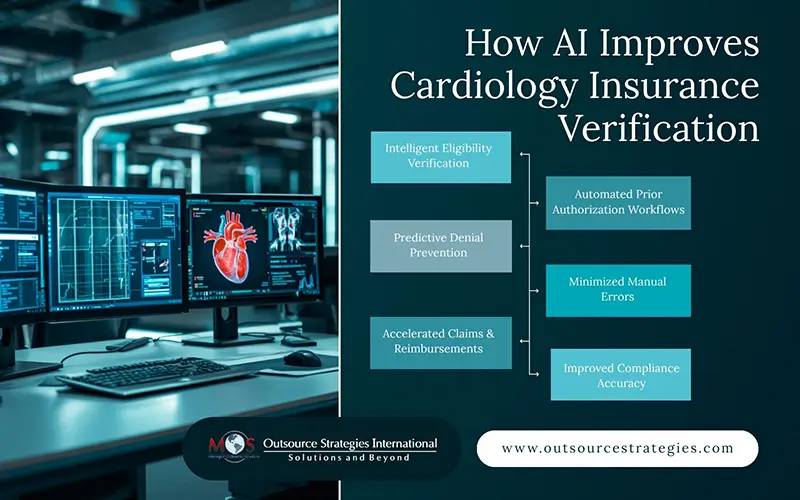
- Smarter Eligibility Checks before Appointments: AI tools can instantly access payer databases and confirm whether a patient’s coverage is active and applicable for specific cardiology services. Instead of spending valuable staff hours on phone calls and manual lookups, AI systems automate the process and provide immediate updates regarding:
- Coverage status
- Copays and deductibles
- Out-of-pocket expenses
- Referral requirements
- Network participation
- Procedure-specific limitations
- Automated Prior Authorization Management: Many advanced cardiac procedures require approval before treatment can begin. AI tools simplify authorization workflows by:
- Identifying services requiring authorization
- Collecting the required clinical documentation
- Tracking authorization requests automatically
- Monitoring payer responses in real time
- Sending alerts for pending approvals or missing documents
By automating these steps, practices can reduce delays in patient care and prevent denials caused by missing or incomplete authorizations.
- Predictive Analytics for Denial Prevention: AI systems can analyze past denials and predict which claims are most likely to face rejection. Predictive analytics can flag issues such as:
- Incorrect patient demographics
- Missing modifiers
- Invalid diagnosis-procedure combinations
- Non-covered services
- Authorization mismatches
- Coding inconsistencies
- Reducing Human Error through Automation: AI-driven automation improves accuracy by:
- Eliminating repetitive manual tasks
- Standardizing verification workflows
- Automatically updating payer policy changes
- Validating data across integrated systems
- Reducing duplicate entries
- Faster Claims Processing and Reimbursements: When insurance verification is completed accurately at the beginning of the patient journey, claims move through the reimbursement cycle more efficiently. AI systems help ensure that:
- Claims are clean before submission
- Documentation is complete
- Authorization data is attached correctly
- Coding errors are minimized
- Faster claim approvals
- Reduced accounts receivable days
- Improved cash flow
- Fewer payment delays
- Strengthening Compliance and Regulatory Accuracy: Healthcare regulations and payer policies frequently change. AI solutions continuously monitor payer rule updates and automatically apply changes to verification workflows. This helps reduce compliance risks related to:
- Incorrect coding
- Documentation gaps
- Authorization failures
- Billing inaccuracies
This enables cardiology teams to resolve insurance issues before appointments take place, reducing last-minute surprises and payment delays.
This helps cardiology practices maintain consistent and compliant billing operations.
As a result, practices experience:
Efficient verification workflows strengthen the financial performance of cardiology organizations.
By maintaining accurate and updated verification processes, practices can avoid costly audits and reimbursement complications.
The Future of Cardiology Revenue Cycle Management
As healthcare systems become more digitized, AI adoption in revenue cycle management will continue to grow. Future AI technologies may offer even deeper integration with electronic health records, payer systems, and predictive analytics platforms. Future trends in AI may include:
- Real-time denial prediction dashboards
- Automated appeals management
- Voice-assisted verification tools
- Advanced payer behavior analysis
- Intelligent coding assistance
- Personalized patient billing estimates
For cardiology practices, investing in AI-driven solutions is becoming less of an option and more of a strategic necessity.
The growing complexity of cardiology billing and reimbursement makes accurate insurance verification more important than ever. Traditional manual workflows lead to delays, errors, and denied claims that negatively impact both providers and patients.
By implementing AI in cardiology insurance verification, healthcare organizations can streamline administrative processes, improve accuracy, accelerate reimbursements, and reduce costly denials.
From automated eligibility checks and prior authorization management to predictive denial prevention, AI-powered insurance verification is helping cardiology practices operate more efficiently in an increasingly demanding healthcare environment.
As providers continue exploring how AI reduces claim denials in cardiology practices, it is clear that artificial intelligence is no longer just a technological advantage. It is becoming a critical component of modern healthcare revenue cycle management.
Optimize cardiology insurance verification and reduce costly claim denials with AI-powered solutions.

More from This Author