
In today’s healthcare ecosystem, securing payer approvals is essential for timely reimbursement. However, when services are delivered without prior authorization, the retro authorization process or retrospective authorization in healthcare becomes essential. It enables providers to request approval after services are rendered, helping recover reimbursements under specific conditions.
With the increasing adoption of Artificial Intelligence (AI), healthcare providers and medical billing companies can now streamline the retro authorization process more effectively. AI-powered solutions automate documentation, detect missing authorizations, and even predict approval outcomes, improving accuracy while reducing administrative workload and enhancing reimbursement success rates. Understanding how retro authorization works, along with the key components of retro authorization request in medical billing, is vital to minimize denials and maintain revenue cycle efficiency. While it provides a second chance for reimbursement, retro authorization is more scrutinized by payers. Therefore, accuracy, documentation, and adherence to payer guidelines are critical.
What Is Retro Authorization
Retro authorization is the process of requesting payer approval after a medical service has been performed. Unlike prior authorization, which is obtained before treatment, retrospective authorization in healthcare is typically used in emergency situations, administrative delays, or unforeseen circumstances where prior authorization was not obtained.
Partner with our expert medical billing experts to streamline documentation and boost approval rates.
How Does the Retro Authorization Process Work
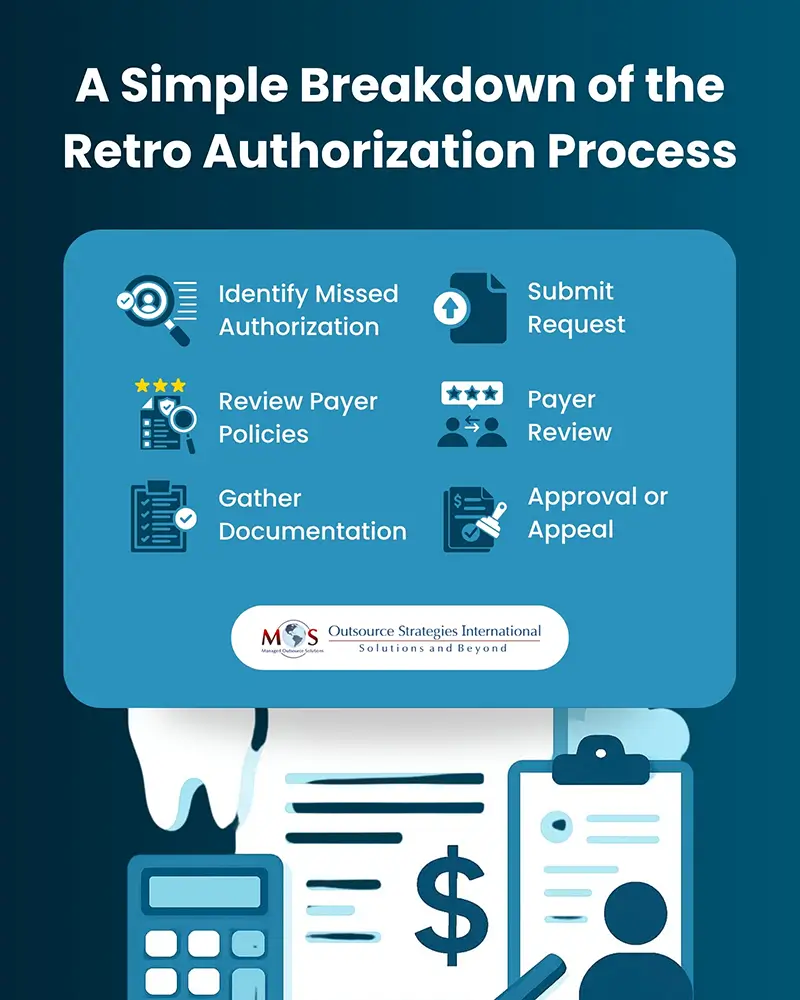
The retro authorization process involves several structured steps that ensure the payer has enough information to evaluate the request:
- Identify Missed Authorization: Determine cases where prior authorization was not obtained.
- Review Payer Policies: Check payer-specific rules, timelines, and eligibility criteria for retrospective authorization in healthcare.
- Gather Documentation: Compile all documents required for retro authorization approval, including clinical and billing records.
- Submit the Request: Send the retro authorization request via payer portals, EHR systems, or other approved channels.
- Payer Review and Decision: The payer evaluates medical necessity, documentation, and compliance.
- Approval or Appeal: Approved claims proceed to reimbursement; denied cases may be appealed with additional evidence.
Key Components of Retro Authorization Request
To increase the likelihood of approval, it is essential to include all components of retro authorization request in a clear and structured manner. Missing or incomplete information is one of the most common reasons for denial.
Below are the key components of a retro authorization request in medical billing:
- Patient Information: Accurate patient details are fundamental. These include:
- Full name
- Date of birth
- Insurance ID
- Contact details
Any mismatch in patient data can lead to delays or rejection.
- Provider Information: The request must clearly identify the healthcare provider:
- Provider name and credentials
- National Provider Identifier (NPI)
- Facility details
- Contact information
This helps the payer validate the legitimacy of the service provider.
- Service Details: Detailed information about the medical service is required:
- Date(s) of service
- Type of procedure or treatment
- CPT/HCPCS codes
- Diagnosis codes (ICD-10)
These details help insurers assess whether the service aligns with coverage policies.
- Clinical Documentation: Clinical records are among the most important documents required for retro authorization approval. These include:
- Physician notes
- Admission and discharge summaries
- Lab results and imaging reports
- Treatment plans
- Medical Necessity Justification: Payers require validation of why the service was medically necessary. This should:
- Align with clinical guidelines
- Highlight urgency or emergency conditions
- Explain why prior authorization was not obtained
- Reason for Retro Request: A well-defined reason must be provided for requesting authorization after the service. Common reasons include:
- Emergency situations
- System or administrative errors
- Delayed insurance verification
- Unforeseen medical complications
- Supporting Documents: In addition to clinical records, other supporting documents may be required:
- Referral letters
- Prior communication with payer
- Proof of eligibility at the time of service
- Consent forms
These documents strengthen the overall request.
- Timely Submission: Even though it is retrospective, the request must be submitted within the payer’s specified timeframe. Missing deadlines can lead to automatic denial, regardless of medical necessity.
Documents Required for Retro Authorization Approval
To summarize, the most essential documents required for retro authorization approval include:
- Patient and insurance details
- Provider credentials
- Clinical notes and medical records
- Diagnostic and lab reports
- Procedure and diagnosis codes
- Justification of medical necessity
- Explanation for delayed authorization
- Any additional payer-specific forms
Ensuring that all documentation is complete and accurate significantly increases approval chances.
Looking to simplify retro authorization and avoid costly denials?
Challenges in the Retro Authorization Process
While retro authorization can help recover revenue, it comes with several challenges:
- Strict Payer Guidelines: Each insurer has different rules and deadlines, making retrospective authorization difficult to standardize.
- High Denial Rates: Retro authorization requests are more scrutinized than prior approvals, increasing the chances of rejection.
- Incomplete Documentation: Missing or insufficient documents required for retro authorization approval can lead to delays or denials.
- Time Constraints: Requests must be submitted within strict timelines, and delays can result in lost reimbursement opportunities.
- Administrative Burden: The retro authorization process requires significant manual effort, increasing workload for billing and RCM teams.
- Inconsistent Communication with Payers: Poor follow-up or unclear communication can cause delays and denials.
- Coding and Billing Errors: Incorrect CPT/ICD codes can weaken the key components of a retro authorization request in medical billing.
Addressing these challenges requires a proactive and organized approach.
How AI Is Improving the Retro Authorization Process
AI is transforming the retro authorization process by:
- Automating documentation workflows
- Identifying missing authorization requirements
- Improving accuracy in coding and data extraction
- Reducing administrative workload
- Enhancing approval success rates
For medical billing companies, AI-driven solutions enable faster processing and more consistent outcomes.
The retro authorization process acts as an essential fallback when prior authorization is not obtained. Success depends on understanding the key components of a retro authorization request in medical billing and ensuring that all documents required for retro authorization approval are accurate and complete. For healthcare providers and medical billing companies, attention to detail in this stage and a structured approach supported by AI and strong documentation practices can reduce denials, improve reimbursement rates, and optimize revenue cycle performance.

More from This Author