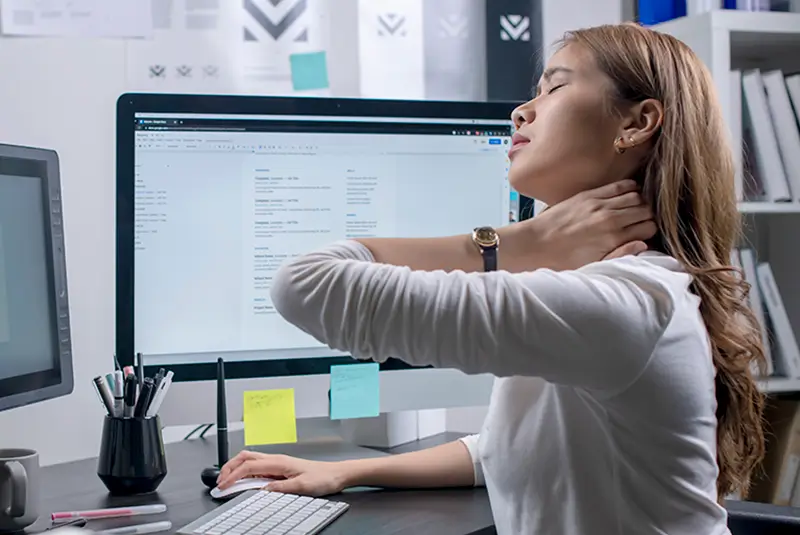
Technology offers many advantages, but it can also contribute to certain health issues. One growing concern is text neck. The condition, also called tech neck, refers to the neck pain and strain caused by prolonged downward gazing at phones or hunching over computers. Text neck is a growing concern across the nation, with research showing that it affects up to 27 to 48 percent of workers and about 73 percent of college students.
Management of this musculoskeletal condition typically involves a combination of chiropractic techniques and rehabilitative physical therapy. Accurate ICD-10 coding is essential for proper diagnosis reporting and reimbursement. As neck pain (cervicalgia) can result from various underlying conditions, AI medical coding can help improve accuracy and support appropriate ICD-10 code assignment.
Enhance medical coding for musculoskeletal conditions with AI-powered MedGenX and expert validation.
Common Signs and Symptoms of Text Neck
Tech neck presents with a wide range of symptoms. While mild neck pain can be addressed by making postural and ergonomic changes, persistent pain requires medical attention. Typical signs and symptoms include:
- Stiff neck: difficulty moving the neck after prolonged use
- Pain: a dull ache or a sharp, severe sensation usually present in the lower part of the neck, but can be localized to one part, typically the lower neck
- Radiating pain: pain may radiate into the shoulders and arms
- Muscular weakness: loss of strength in the shoulders muscles, especially the external rotators
- Headache: tension type headaches due to tight muscles in the lower back of the neck
- Reduced range of motion: muscle imbalances, poor posture (forward head tilt), or joint stiffness decreases range in the cervical and upper thoracic spine
- Numbness or tingling: sensations in the arms, hands, or fingers caused by nerve irritation
- Jaw pain: cervical spine misalignment can affect the temporomandibular joint (TMJ)
- Eye strain: caused by prolonged gazing at the screen
- Fatigue: Poor posture reduces lung capacity and causes fatigue
If left untreated, tech neck can ultimately lead to chronic pain, early onset of arthritis, spinal degeneration, disc compression, and nerve irritation.
ICD-10 Codes for Text Neck Syndrome
“Text neck” is not an official ICD-10 diagnosis. The ICD-10 codes for neck pain due to device use are typically classified under M54.2 (cervicalgia), M53.1 (cervicocranial syndrome), and related musculoskeletal categories.
Tech neck symptoms and relevant ICD-10 codes:
- Posture-related Neck Pain
- M54.2 Cervicalgia
- Nerve Impingement
- M50.1 Nerve impingement
- Cervicocranial Syndrome and Cervicobrachial Syndrome
- M53.0 Cervicocranial syndrome
- M53.1Cervicobrachial syndrome
- Neck Muscle Spasm
- M62.831 Muscle spasm of neck
- Back Muscle Spasm
- M62.830 Muscle spasm of back
- Cervical Disc Degeneration
- M50.30 Other cervical disc degeneration, unspecified cervical region
- Shoulder Pain
- M25.51 Shoulder pain
- M25.511 Pain in right shoulder
- M25.512 Pain in left shoulder
- M25.519 Pain in unspecified shoulder
- Cervical Herniated Disc
- M50.30 Other cervical disc degeneration, unspecified cervical region
- M50.31 … high cervical region
- Cervical Disc Displacement or Herniation
- M50.20 Other cervical disc displacement, unspecified cervical region
- M50.21 Other cervical disc displacement, high cervical region
- M50.22 Other cervical disc displacement, mid-cervical region
- M50.23 Other cervical disc displacement, cervicothoracic region
- Headache
- R51 Headache
The most common code used for general neck pain is:
If the posture or displaced disc compresses nerves, causing pain radiating down the arm (radiculopathy), report:
Forward-head posture at a typical screen-viewing angle fatigues the deep neck flexors and strains the upper back muscles, irritating nerves that branch into the shoulders, arms, and base of the skull, causing these conditions. Relevant codes:
For overworked neck muscles caused by prolonged forward bending:
When tech neck causes muscle tightness from prolonged flexion, use:
For shoulder pain symptoms like pain and stiffness caused by slumping and bending the head forward to look at screens:
When the cervical spine is subjected to constant pressure from tech neck, the discs can begin to wear down or become damaged, leading to a cervical herniated disc.
Forward head posture from looking down at screens can contribute to cervical disc displacement or herniation. The ICD-10 code to report is:
To report headache, a common symptom of text neck, use:
As text neck itself is not a formal ICD-10 diagnosis, correct coding for the condition depends on accurate documentation.
ICD-10 Documentation Guidelines for Posture-Related Musculoskeletal Conditions
For proper documentation and coding of posture-related issues, providers must specify the musculoskeletal condition, symptoms, anatomical location, severity, and any associated functional impairment. Accurate text neck medical billing and coding requires clear documentation of the following:
Chief Complaint
- Neck pain after prolonged computer use
- Upper back stiffness
- Headaches associated with poor posture
- Shoulder tension from device use
Anatomical Specificity
- Cervical spine
- Thoracic spine
- Trapezius region
- Shoulder girdle
- Lumbar region (if involved)
Laterality (if applicable)
Examples:
- Right trapezius spasm
- Bilateral shoulder pain
Clinical Findings
Document:
- Forward head posture
- Rounded shoulders
- Reduced cervical ROM
- Muscle spasm/tightness
- Trigger points
- Kyphotic posture
- Postural imbalance
Etiology / Contributing Factors
Examples:
- Prolonged laptop use
- Mobile phone overuse
- Sedentary work
- Ergonomic strain
- Repetitive stress
Functional Impact
Examples:
- Difficulty working at computer
- Sleep disturbance
- Reduced concentration
- Pain with prolonged sitting
Benefits of AI-Powered Coding for Posture-Related Musculoskeletal Conditions
AI medical coding tools like MedGenX powered by DeepKnit AI can significantly improve the accuracy, efficiency, and consistency of documenting and coding posture-related musculoskeletal conditions.
MedGenX can analyze clinical notes and suggest the most appropriate ICD-10 codes for text neck based on documented findings. For example, if the provider documents forward head posture, neck pain, trapezius spasm, and prolonged computer use, this AI assistant may recommend:
- M54.2 — Cervicalgia
- R29.3 — Abnormal posture
- M62.838 — Muscle spasm
MedGenX also improves workflow through automated code suggestions, real-time documentation prompts, NLP-based interpretation of non-standard terms, and reduced manual review time. By combining AI-driven efficiency with certified coder validation, this advanced tool achieves accurate, compliant, and high-quality documentation.
Physical therapy and chiropractic billing services that leverage AI-driven medical coding reduce claim denials, enhance compliance and audit readiness, strengthen multidisciplinary care coordination, and generate higher-quality clinical data.
Improve claims processing for postural conditions with AI-assisted physical therapy coding.

More from This Author